Home Categories Deals Sign Up
Updated: June 11, 2026

Placid in Action: Creative Automation at Any Scale

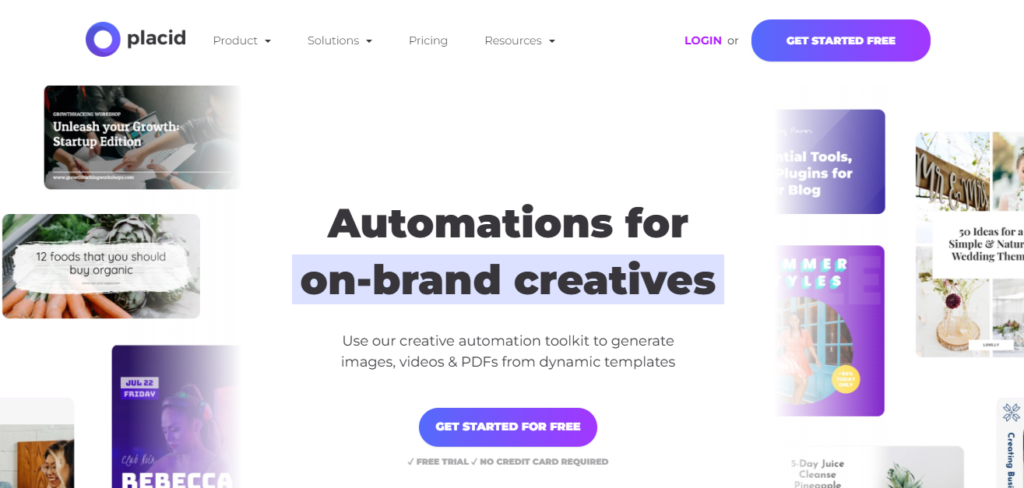
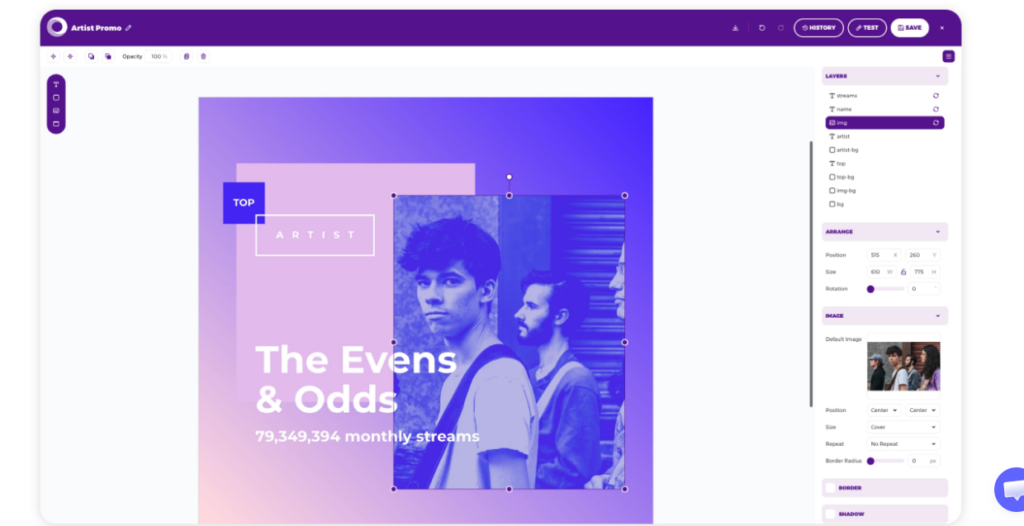
Placid is a creative automation toolkit built for marketing teams, developers, and agencies who need to produce consistent, on-brand images, PDFs, and videos at volume — without re-doing design work manually for every variation.

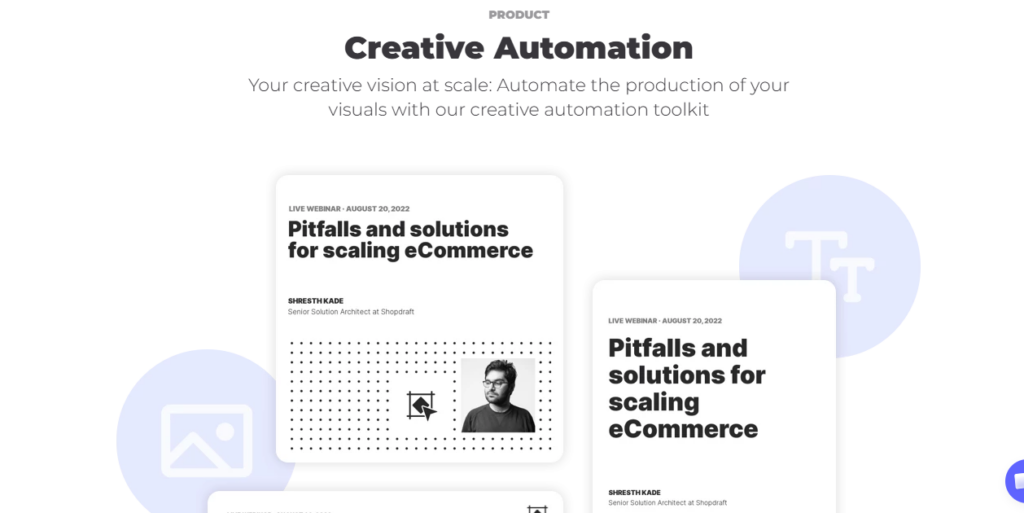
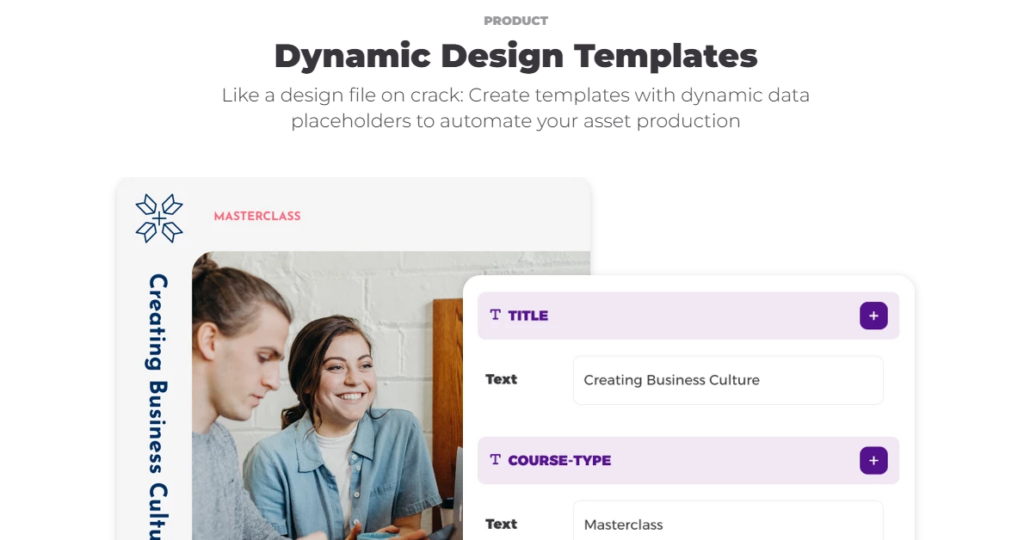
You build a dynamic template once in the Placid editor, mark text and image layers as variable parameters, and then generate thousands of branded visuals by passing data via REST API, URL, or no-code integrations like Make.com, n8n, and Zapier.

Pat Walls, Founder of Starter Story, uses it to generate thousands of image assets in seconds for Instagram, Twitter, Facebook, and Pinterest.

Lukas Hoffmann, CTO of Streamheroes, called the integration “quick and uncomplicated” with “huge” application possibilities. Mikkel Steen, CEO of Artboost, says his team no longer thinks about share images — “they're done and always beautiful.”

Key Capabilities

Placid covers three primary generation types from a single template. The Image API renders PNG, JPG, and WebP from dynamic templates at 1 credit per image, supporting canvas sizes up to 16,000 pixels for high-resolution print and digital output.

The PDF API generates multi-page documents at 2 credits per page for personalized certificates, invoices, and marketing materials. The Video API creates up to full HD (1920×1080) videos at 10 credits per 10 seconds of output, supporting slideshow, animated, and data-driven video formats.

All three generation types work through the same REST API or URL API, and are also available in Make.com, n8n, Airtable, Zapier, Webflow, WordPress, Ghost, and ChatGPT integrations without writing a line of code. For AI agent teams, a first-class MCP Server connects Claude Code, Cursor, Copilot, and other agent frameworks to Placid's full template and generation stack.

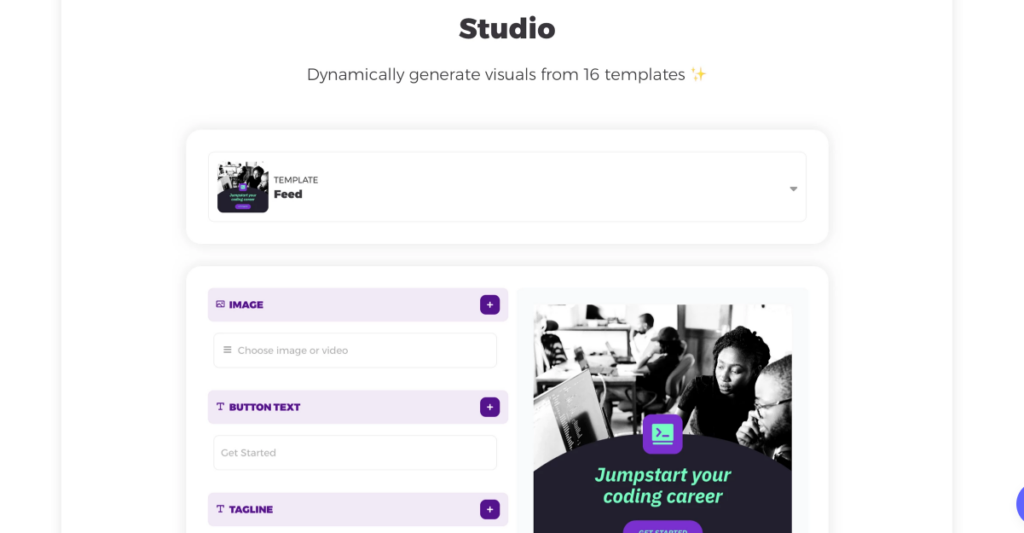
On-demand use cases are handled by Placid Studio — a shareable page with a form interface where anyone (including non-technical clients) can fill in variables and generate branded outputs without touching the API.

Who Gets the Most Out of It

Developers building OG image generation, certificate issuance, or personalized campaign visual features drop in the REST or URL API with SDKs and get branded output in milliseconds.

Marketing teams and agencies set up Make.com or n8n workflows that pull data from Google Sheets or Airtable, generate branded social media visuals automatically, and post to platforms without human intervention — a workflow demonstrated across dozens of community tutorials.

SaaS builders who need to embed a design editor inside their own product use the Editor SDK, which drops the full Placid template editor into any React or Vue app as a white-labeled component without building design infrastructure from scratch.

Is It Worth It?

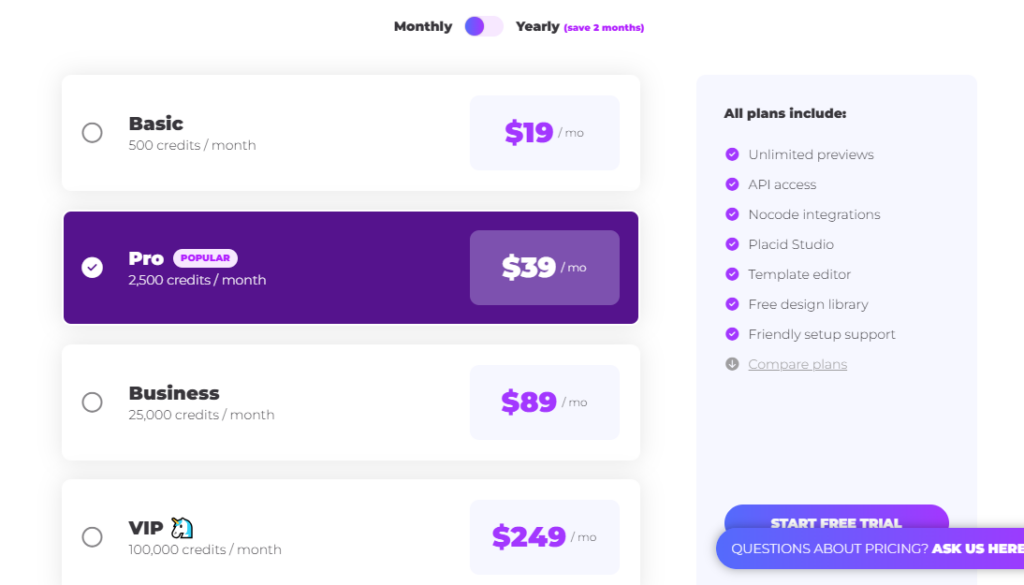
At $19/month for 500 credits — with unused credits rolling over up to double your monthly budget and no overage fees charged — the Basic plan is a low-risk entry point for small teams running modest automation volumes.

The Pro plan at $39/month for 2,500 credits handles most real marketing automation workloads, and the Business plan at $89/month for 25,000 credits suits agencies running multi-client campaigns at scale.

The credit rollover policy and the no-overage-fees model are genuinely user-friendly features that most competing platforms don't offer — Placid simply stops generating when credits run out rather than charging you surprise fees.

Placid is a creative automation toolkit developed by Placid.app GmbH that lets developers, marketers, and agencies generate on-brand images, PDFs, and videos from dynamic templates via REST API, URL API, MCP Server, and no-code integrations including Make.com, n8n, Zapier, Airtable, Webflow, and WordPress.

You design one template with dynamic variable layers in Placid's drag-and-drop editor and then render thousands of personalized visual variations by passing data at generation time — with no manual design work required per output. The platform supports canvas sizes up to 16,000 pixels for images, multi-page PDFs, and full HD (1920×1080) video generation.

• Dynamic Template Engine — Renders on-brand images (PNG/JPG/WebP up to 16k pixels), multi-page PDFs, and full HD videos from a single reusable template by substituting dynamic text, image, color, and video layer parameters at generation time via API, URL, or no-code workflow.

• REST API & URL API — Two rendering interfaces in one: the REST API accepts JSON parameter payloads for programmatic batch generation, while the URL API generates creatives by constructing a simple URL with query string parameters — embeddable directly in emails, web pages, and no-code tools without an authentication call.

• MCP Server for AI Agents — First-class Model Context Protocol integration connects Claude Code, Cursor, Copilot, ChatGPT, and other agent frameworks to Placid's full template and generation stack, enabling AI agents to generate and publish branded visuals natively during task execution.

• Placid Studio — A shareable on-demand generation interface where users fill in a customizable form to generate branded outputs without API access, supporting password protection, unlimited custom studios per workspace, and public studio pages for client-facing creative request workflows.

• No-Code Integrations — Native modules for Make.com, n8n, Zapier, Airtable, Webflow, WordPress, Ghost, and ChatGPT let non-developers trigger template renders from any data source and pipe branded outputs into connected platforms without writing code.

• Editor SDK — Embeds the full Placid template editor inside your own SaaS or React/Vue application as a white-labeled component, with Canvas Previews and Editor Component features available on paid plans — letting you offer branded design capabilities to your users without building design infrastructure.

• Credit Rollover System — Unused monthly credits roll over to the next month up to a maximum of double your plan's monthly budget, effectively giving you a savings buffer for low-usage months that applies automatically to your next high-volume period.

• Mobile SDK — Lets iOS and Android developers generate Placid creatives natively inside mobile apps, with 1 license on Basic, 2 on Pro, 5 on Business, and 10 on VIP for multi-app deployments.

Pros
  • Credits roll over month-to-month up to double your monthly budget — no wasted spend during low-volume periods
  • No overage fees — Placid stops generating when credits run out rather than charging surprise fees
  • URL API generates images without an authentication call — just embed a parameterized URL directly in emails or web pages
  • MCP Server gives Claude Code, Cursor, and ChatGPT native access to Placid templates and generation without separate API key setup
  • Canvas sizes up to 16,000 pixels support high-resolution print, digital, and ad creative output from the same template
  • Free trial available with complimentary credits and no credit card required
  • Placid Studio shareable forms let non-technical clients generate branded outputs on demand without API access
Cons
  • ×No permanent free plan — only a time-limited free trial with complimentary credits before a paid subscription is required
  • ×Video generation is credit-intensive at 10 credits per 10 seconds — a 2-minute video consumes 120 credits, burning through the Basic plan's 500 monthly credits in just 4 videos
  • ×White-label on the Editor SDK is only available on the VIP plan ($249/month) or via custom Enterprise arrangement — expensive for agencies wanting branded embed at lower volume
  • ×Public Studio Pages are tightly limited: 1 page on Basic, 5 on Pro, 20 on Business — restrictive for agencies managing many client-facing request portals
  • ×No native social media publishing — unlike Orshot or Simplified, Placid generates the visual but does not post it to social platforms directly; you need a separate tool or workflow step for publishing

Placid is purpose-built for teams that need consistent, branded visual output at volume without manual design repetition.

• Developers building OG image generation, certificate issuance, or personalized campaign visual APIs — the REST and URL APIs with SDKs let you render branded outputs in milliseconds from your own codebase, with canvas support up to 16,000 pixels for any format or resolution requirement.

Marketing agencies and automation operators on Make.com or n8n — Placid's native no-code modules trigger renders from Google Sheets, Airtable, or CRM data, auto-generate social media visuals, and pipe outputs into connected platforms for a fully hands-off branded content pipeline across multiple client accounts.

E-commerce teams producing high-volume product visuals — feed product titles, prices, and images from your catalog into a Placid template and generate hundreds of branded product cards, ad banners, and promotional graphics per batch without designer involvement.

• SaaS builders adding design capabilities to their product — the Editor SDK drops the full Placid template editor into your React or Vue app as a white-labeled component, giving your users professional design tools without you building image generation infrastructure from scratch.

Basic ($19/mo)500 credits/month (~500 images, 250 PDF pages, or ~8 min of video), unlimited projects, unlimited custom templates, high-resolution designs, free design library, REST API, URL API, all no-code integrations (Make, n8n, Zapier, Airtable, Webflow, WordPress, Ghost, ChatGPT, MCP), 1 Mobile SDK license, unlimited custom studios, 1 public Studio page, Canvas Previews in Editor SDK, credits roll over up to 1,000 total, no overage fees, livechat support.
Pro ($39/mo)2,500 credits/month (~2,500 images, 1,250 PDF pages, or ~41 min of video), everything in Basic, 2 Mobile SDK licenses, 5 public Studio pages, password protection for Studio pages, custom credit limit option, credits roll over up to 5,000 total, livechat support.
Business ($89/mo)25,000 credits/month (~25,000 images, 12,500 PDF pages, or ~6.9 hrs of video), everything in Pro, 5 Mobile SDK licenses, 20 public Studio pages, Editor Component in Editor SDK, credits roll over up to 50,000 total, livechat support and Zoom calls.
VIP ($249/mo)100,000 credits/month (~100,000 images, 50,000 PDF pages, or ~27.7 hrs of video), everything in Business, 10 Mobile SDK licenses, 50 public Studio pages, white-label Editor SDK (contact for details), credits roll over up to 200,000 total, priority livechat support and Zoom calls.

Placid stands apart from generic image generation APIs by combining a no-code-first approach with serious developer infrastructure and an honest credit model.

• Credit Rollover with No Overage Fees — Placid never charges you surprise overage fees when you exceed your monthly credit limit — it simply stops generating until you upgrade. Unused credits roll over up to double your monthly budget, creating a natural usage buffer that most competing rendering APIs don't provide.

• URL API for Zero-Auth Generation — Unlike REST-only competitors, Placid's URL API lets you generate branded images by constructing a simple parameterized URL that you embed directly in emails, web pages, or no-code tools — no authentication call, no SDK, no backend required for basic generation use cases.

• Placid Studio for Non-Technical Users — Placid Studio is a shareable, form-based on-demand generation interface that lets clients, teammates, or end users generate branded outputs by filling in a form — without API knowledge, without browser extension installs, and without accessing your workspace or templates directly.

ChatGPT Native Integration — Placid is one of the only creative automation platforms with a native ChatGPT integration, letting you trigger template renders and generate branded visuals directly from a ChatGPT conversation or GPT Action — bridging the gap between AI text generation and branded visual output in a single workflow.

Placid integrates with every layer of modern marketing and development stacks across both code and no-code environments.

• Make.com, n8n, Zapier, and Airtable — native modules that trigger Placid renders from automation workflows, accepting dynamic data from spreadsheets, forms, CRMs, or databases and delivering rendered images, PDFs, and videos to connected output destinations.

• Webflow, WordPress, and Ghost — direct CMS integrations that automatically generate social share images, OG images, and post thumbnails from your content at publish time, keeping visual assets in sync with your publishing workflow without manual design steps.

ChatGPT and MCP Server — native ChatGPT integration for conversational render triggering, and an MCP Server for connecting Claude Code, Cursor, Copilot, and other AI agent frameworks to Placid's template and generation stack for autonomous visual production during agent task execution.

• Mobile SDK (iOS and Android) — native mobile SDK for generating Placid creatives inside iOS and Android applications, with 1–10 licenses depending on plan tier for multi-app deployments and in-app share image generation use cases.

CategoryScoreWhy It Matters
Accuracy & Reliability4.6/5Placid has been used in production by high-profile customers including Starter Story, Streamheroes, and Artboost — all publicly referenced on the homepage with specific outcomes — demonstrating consistent template-accurate rendering at scale. The platform's support for canvas sizes up to 16,000 pixels and full HD video output reflects a robust rendering engine. Minor reliability gaps reported by users involve occasional delays in high-volume PDF batch generation jobs, but these are infrequent according to community feedback on NoCode.Tech and Ideal Online Business.
Ease of Use4.3/5Placid's drag-and-drop template editor is accessible to designers without coding experience, and the no-code integrations for Make.com, n8n, and Zapier are well-documented with active community tutorials — including a popular 20-minute Make.com + Placid social media automation walkthrough that has driven thousands of new users to the platform. The URL API is uniquely beginner-friendly, requiring no authentication for parameterized image generation. The Editor SDK and REST API add developer depth without cluttering the primary UI for non-technical users.
Functionality & Features4.5/5Placid covers image, PDF, and video generation from a single template ecosystem, with 9+ native no-code integrations, REST API, URL API, MCP Server, Placid Studio, Editor SDK, and Mobile SDK — a comprehensive toolkit that serves developers, no-code operators, and AI agent builders simultaneously. The ChatGPT native integration and MCP Server for AI agents are forward-looking features that most competing rendering platforms have not yet implemented. The only notable gap is the absence of native social media publishing, which requires a separate workflow step for teams wanting end-to-end automation.
Performance & Speed4.4/5Image generation via Placid's REST and URL APIs typically completes in under 2 seconds for standard template sizes, making it suitable for real-time OG image generation on page load. PDF and video generation are slower relative to images due to multi-page and frame processing, but remain within acceptable latency windows for scheduled batch workflows. The URL API's zero-authentication rendering path is particularly fast for parameterized image embedding use cases.
Customization & Flexibility4.5/5Dynamic variable layers support text, images, colors, shapes, and video elements — giving teams precise control over every parameter of each rendered output without separate templates per variation. Canvas size support up to 16,000 pixels covers everything from social thumbnails to billboard-resolution print assets. The Editor SDK white-label option, password-protected Studio pages, custom credit limits on Pro and above, and per-project template organization give meaningful structural flexibility for agencies and SaaS builders managing complex multi-client workloads.
Data Privacy & Security4.2/5Placid.app GmbH is a German company operating under GDPR compliance, with a Data Processing Agreement (DPA) available on all paid plans — a stronger data privacy baseline than most US-based competitors offer by default. GDPR compliance and DPA availability are listed as standard features across all tiers on the official pricing page. No SOC 2 certification is publicly documented, which remains a gap for enterprise buyers with formal security compliance requirements beyond GDPR.
Support & Resources4.3/5Placid offers livechat support on all paid plans and Zoom calls on Business and VIP tiers — a strong support structure for a $19/month entry price. The official blog at placid.app/blog includes detailed tutorials for Airtable, Zapier, and video slideshow automation workflows. The platform benefits from an active third-party tutorial community across YouTube, Make.com community forums, and n8n community — with dedicated walkthroughs from automation educators confirming the tool's real-world integration quality.
Cost-Efficiency4.6/5Placid's $19/month Basic plan for 500 rolling credits with no overage fees is one of the most cost-efficient entry points in the creative automation API space — cheaper than Orshot ($39/mo) and Bannerbear ($49/mo) at similar capability levels. The credit rollover system effectively gives low-volume months a savings buffer that transfers to high-volume months, making actual per-image cost lower than the plan price suggests for teams with variable workloads. The no-overage-fees policy eliminates budget risk entirely for teams operating near their credit limit.
Overall Score4.4/5Placid is the best-value creative automation API in 2026 for development teams and marketing agencies who need consistent, on-brand image, PDF, and video generation at scale — combining developer-grade REST and URL APIs, 9+ no-code integrations, MCP Server for AI agents, Placid Studio for non-technical users, GDPR compliance, credit rollover, and no overage fees at a starting price of $19/month. The only meaningful limitation for marketing-first teams is the absence of native social media publishing, but for teams using Make.com or n8n as their automation backbone, that gap is closed in one additional workflow step.

Placid is the most developer-friendly and no-code-accessible creative automation platform available in 2026 for teams who need consistent, on-brand images, PDFs, and videos generated at scale from reusable dynamic templates.

Its combination of REST API, URL API, MCP Server, native no-code integrations across 9+ platforms, Placid Studio for non-technical users, and an honest credit model with rollover and no overage fees makes it stand out from every competing rendering platform at the $19–$89/month price range.

The only notable limitation for marketing-first teams is the absence of native social media publishing — Placid generates the visual, but posting it still requires a separate workflow step or integration.

Q1.What is Placid and what does it do?
Ans:-Placid is a creative automation toolkit that lets you design one dynamic template and then auto-generate thousands of branded images, PDFs, and videos by passing variable data via REST API, URL API, MCP Server, or no-code tools like Make.com, n8n, and Zapier. It supports canvas sizes up to 16,000 pixels for images, multi-page PDFs, and full HD (1920×1080) video generation. It's used by teams at Starter Story, Streamheroes, and Artboost to automate visual content production at scale.
Q2.How much does Placid cost per month?
Ans:-Placid offers four paid plans: Basic at $19/month (500 credits), Pro at $39/month (2,500 credits), Business at $89/month (25,000 credits), and VIP at $249/month (100,000 credits). All plans include a free trial with complimentary credits and no credit card required. Annual billing is available at a discounted rate.
Q3.What are Placid credits and how do they work?
Ans:-Credits are the billing unit for all Placid generations — 1 credit per image, 2 credits per PDF page, and 10 credits per 10 seconds of video. Previews are always free and unlimited, so you can test your templates and automations without spending any credits. Importantly, Placid charges no overage fees — it simply stops generating when you run out of credits rather than billing you automatically for extras.
Q4.Do Placid credits roll over?
Ans:-Yes. Unused Placid credits roll over to the following month, up to a maximum of double your monthly plan budget. For example, if you're on the Basic plan with 500 monthly credits and use only 200, you'll carry 300 credits forward — giving you up to 800 credits available the following month. This rollover system is automatic and applies on all paid plans.
Q5.Does Placid have a free plan?
Ans:-No. Placid does not offer a permanent free plan. New users get a free trial with a small number of complimentary credits, with no credit card required to sign up. After the trial credits are used, a paid subscription starting at $19/month is required to continue generating creatives.
Q6.What is Placid Studio?
Ans:-Placid Studio is a shareable on-demand generation interface that lets non-technical users generate branded creatives by filling in a simple web form — without needing API access or developer knowledge. You create a Studio page from any template, share the link with teammates or clients, and they fill in the variable fields to generate outputs instantly. Studio pages can be password-protected and customized per use case, with 1 public page on Basic, 5 on Pro, and 20 on Business.
Q7.Does Placid work with Make.com and n8n?
Ans:-Yes. Placid has native modules for both Make.com and n8n, making it one of the most popular creative generation tools in automation community tutorials. You connect using your Placid API key as a credential, then use the Placid module to render images, PDFs, or videos from any template using dynamic data pulled from Google Sheets, Airtable, CRMs, or other connected sources in the same workflow.
Q8.Can Placid generate videos?
Ans:-Yes. Placid's Video API generates slideshow and data-driven videos at up to full HD (1920×1080) resolution, supporting animated and photo-based video formats. Video generation costs 10 credits per 10 seconds of output — a 1-minute video uses 60 credits. You can trigger video generation via REST API, URL API, Make.com, Zapier, and other integrations using the same template workflow as image and PDF generation.
Q9.Does Placid support AI agents like Claude Code or Cursor?
Ans:-Yes. Placid provides an MCP Server that connects Claude Code, Cursor, Copilot, ChatGPT, and other agent frameworks to Placid's full template and generation stack via the Model Context Protocol. Once connected, AI agents can generate branded images, PDFs, and videos natively during task execution without separate API key management or additional integration setup.
Q10.What are the main limitations of Placid?
Ans:-The main limitations are that video generation is credit-intensive (10 credits per 10 seconds), which burns through Basic and Pro plan budgets quickly for video-heavy workflows. There is no native social media publishing — Placid generates the visual but does not post it to platforms directly, so you need a separate workflow step via Make.com or Zapier. White-label Editor SDK branding is only available on the VIP plan ($249/month), and Public Studio Pages are capped at 1 on Basic — restrictive for agencies managing many client-facing portals.

Promote This Tool

Help others discover this tool by sharing this page.

✓ Link copied to clipboard!

Placid Reviews

0.0
Based on 0 reviews
5 star
0%
4 star
0%
3 star
0%
2 star
0%
1 star
0%

Write a Review

Your Rating:

No reviews yet. Be the first to share your thoughts!

31 Similar Placid Tools