Home Categories Deals Sign Up
Updated: June 11, 2026

How Shotstack Works: Programmatic Video at Any Scale

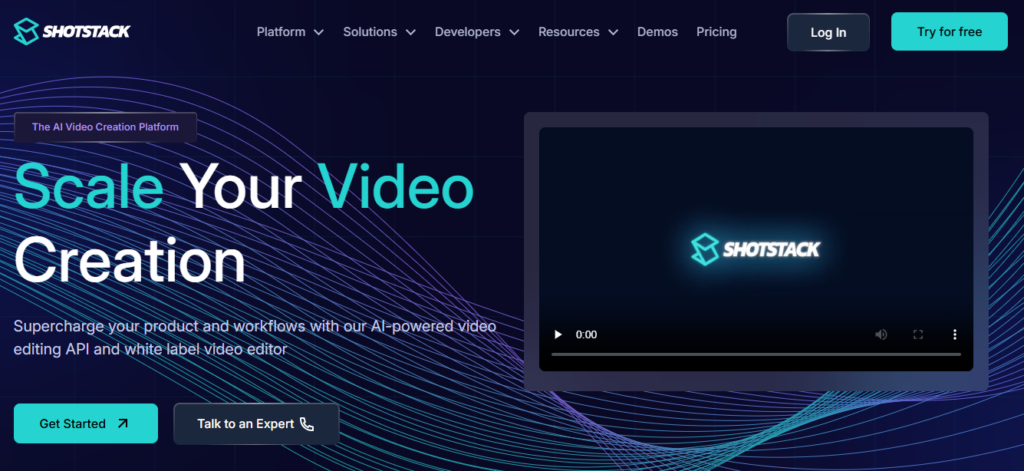
Shotstack is a cloud Video Editing">video editing API that lets developers build, automate, and scale video creation applications without setting up or managing any rendering infrastructure.

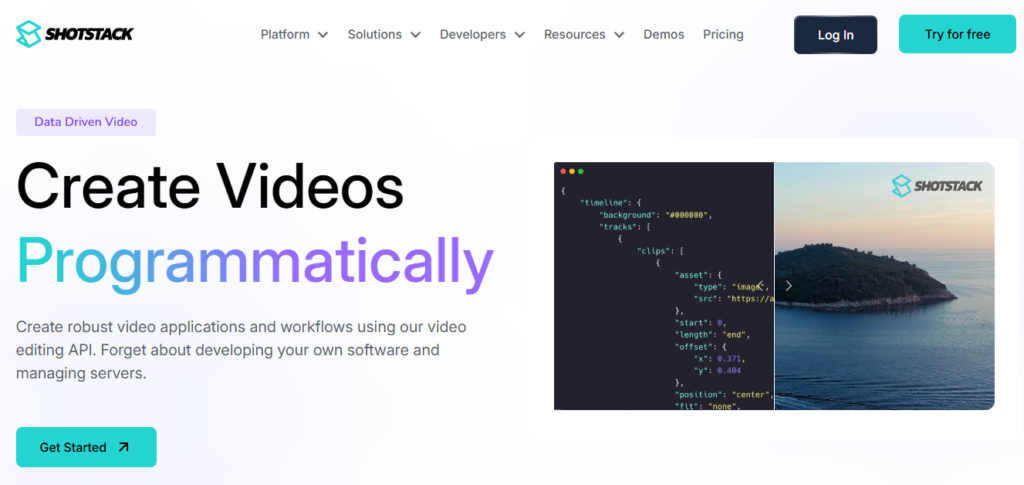
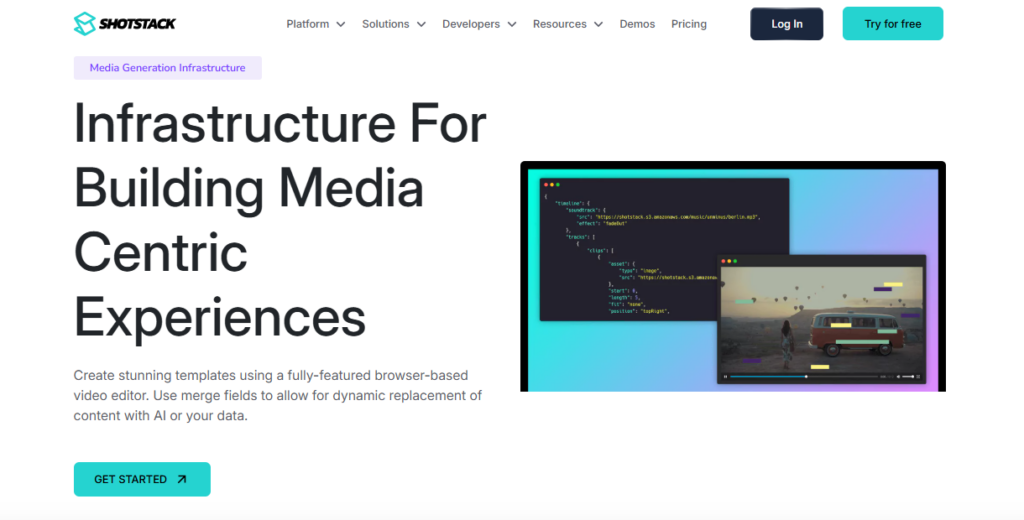
Instead of hiring a video engineering team and spending months building a render farm, you describe how your video should look using a JSON-based editing specification, send one API call, and Shotstack's cloud infrastructure renders the output — at any volume, from one video to millions.

Over 20,000 businesses and developers in 119 countries use it, including Spotify, which generates thousands of videos per day, and IKEA, which used it to deliver personalized video messages to customers at scale.

Key Capabilities

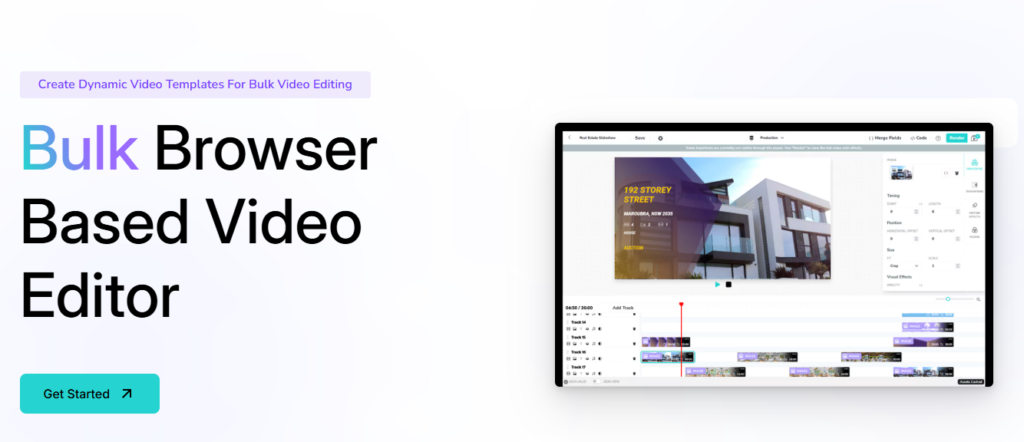
The platform's core Edit API gives you a full virtual timeline — the same model used in desktop editors like Premiere or Final Cut — expressed as JSON. You trim and cut clips, layer text, images, video, HTML, and audio tracks, apply transitions and filters, add subtitles, set opacity, scale and position assets with picture-in-picture support, and output MP4 or GIF at up to 1080p (4K on High Volume plans) at up to 60fps.

Every asset — video, image, font, audio — is loaded by URL, so your existing cloud storage works natively. The Template Studio lets non-developers design templates visually, then exports the JSON automatically and generates ready-to-copy code snippets in cURL, Node, Python, PHP, and Ruby. The Image Generation API creates 10 images per credit from templates, useful for OG images, thumbnails, and real estate renderings.

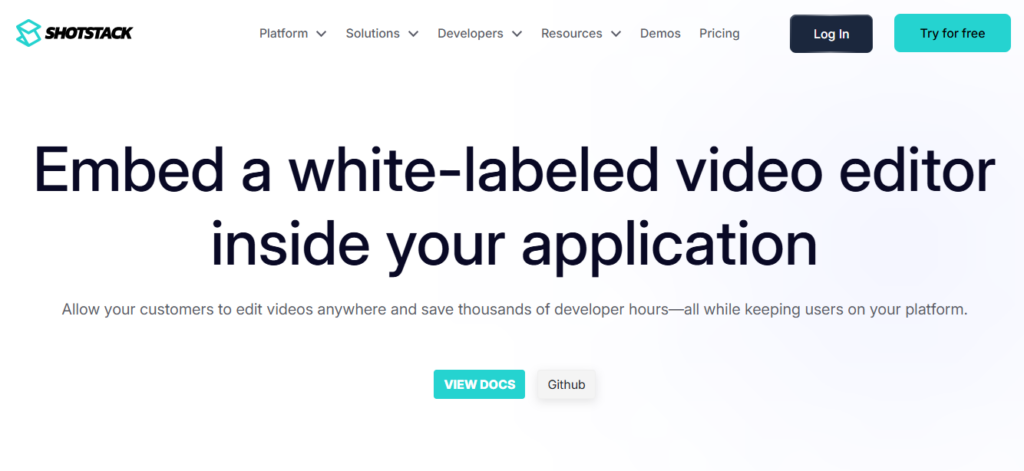
The White-Label Video Editor SDK is source-available under a PolyForm Shield License and drops a full, branded video editing experience into any web application — saving thousands of engineering hours building your own editor.

Storage integrations with AWS S3, Google Cloud, Mux, TikTok, and Google Drive let you route rendered outputs directly to your preferred destination without intermediate storage steps.

Who Gets the Most Out of It

Developers building video-centric SaaS products — real estate slideshow generators, automated subtitle tools, social media video creators, performance marketing ad renderers — get the most immediate value from Shotstack's REST API, SDKs, and template system.

Marketing teams and no-code operators connect Shotstack to Make.com or Zapier to auto-generate product videos from feeds, article-to-video workflows, and personalized campaign content without writing code.

Enterprises running high-frequency video generation — personalized customer messages, automated social clips, daily content pipelines — use the High Volume plan for guaranteed sub-minute render times, 4K resolution, and a dedicated support SLA.

Is It Worth It?

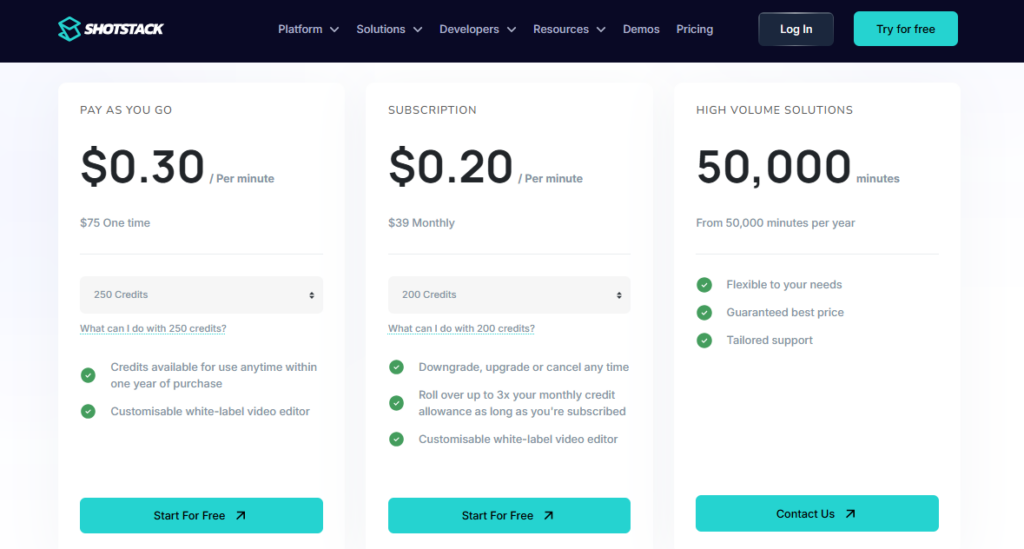
The PAYG plan at $0.30 per minute with a $75 one-time credit pack (250 credits) is ideal for sporadic or unpredictable video production needs — you never pay a monthly fee for unused capacity.

The Subscription plan at $39/month gives you 200 credits at $0.20 per minute — a 33% saving on per-minute cost — with credits rolling over up to 3x your monthly allowance. Overage on the Subscription plan is charged at a 30% premium to your plan rate, so the API never stops mid-pipeline unexpectedly.

For teams spending $500+/month on video production tooling or engineering time, the infrastructure savings alone cover the Shotstack cost within days.

Shotstack is a cloud Video Editing">video editing API developed by Shotstack Pty Ltd and launched in 2019, trusted by over 20,000 businesses and developers across 119 countries — including Spotify and IKEA — to programmatically render, automate, and scale video creation without managing any rendering infrastructure.

Developers describe video edits as JSON using a virtual timeline model and Shotstack's cloud render farm handles all processing, scaling to thousands of concurrent renders.

The platform includes a visual Template Studio, a White-Label Video Editor SDK, an Image Generation API, and native integrations with Make.com, Zapier, AWS S3, Google Cloud, Mux, and TikTok.

• Cloud Video Edit API — Programmatically compose and render videos using a JSON-based virtual timeline supporting multi-track layering of video, images, text, HTML, audio, and subtitles — with trim, cut, transitions, filters, opacity, scale, and picture-in-picture support — output as MP4 or GIF at up to 1080p (4K on High Volume) at up to 60fps.

• Template Studio with Auto Code Generation — Design video templates visually using a drag-and-drop interface, preview renders in-browser, and export ready-to-copy code snippets in cURL, Node, Python, PHP, and Ruby — letting developers skip from visual design to API integration in minutes.

Image Generation API — Renders up to 10 images per credit from Shotstack templates, covering social share images, OG images, thumbnails, real estate photos, and product visuals using the same API key and billing system as video generation.

• White-Label Video Editor SDK — Source-available npm-installable SDK under a PolyForm Shield License that drops a full, customizable video editing experience inside your web application — styled with your logo and brand colors — without building editor infrastructure from scratch.

• URL-Based Asset Loading — Every clip, image, audio file, and font is loaded by URL at render time, meaning your existing AWS S3, Google Cloud Drive, or any CDN-hosted assets plug directly into Shotstack templates with no file upload or format conversion step.

• Concurrent Rendering at Scale — Shotstack's cloud render farm auto-scales to thousands of concurrent renders, handling unpredictable workload spikes without queue management, container configuration, or infrastructure provisioning on your end.

• Storage & Platform Integrations — Routes finished renders directly to AWS S3, Google Cloud Storage, Mux, TikTok, and Google Drive via built-in integrations — eliminating intermediate download-and-re-upload steps in production video pipelines.

• Developer Sandbox — A free sandbox environment with 10 complimentary credits (valid 30 days) provides a live testing environment that renders watermarked outputs for development and integration work before switching to production rendering.

Pros
  • Trusted by Spotify, IKEA, and 20,000+ developers across 119 countries — proven production-grade reliability at massive scale
  • PAYG pricing at $0.30/min with no monthly commitment — ideal for variable or one-off video production needs without ongoing subscription fees
  • Template Studio auto-generates cURL, Node, Python, PHP, and Ruby code snippets — from visual design to API integration in under 10 minutes
  • Credits roll over up to 3x monthly budget on Subscription plan — no wasted spend during low-volume months
  • White-Label Video Editor SDK drops a full branded editor into your app without any engineering build time
  • URL-based asset loading works with any existing cloud storage — no proprietary file upload or format conversion required
  • Concurrent rendering scales to thousands of simultaneous jobs without any infrastructure configuration
Cons
  • ×No permanent free plan — sandbox provides only 10 one-time credits valid for 30 days before payment is required
  • ×4K resolution output is locked behind the High Volume plan (50,000+ minutes/year) — PAYG and Subscription plans are capped at 1080p
  • ×Overage on Subscription plan is charged at a 30% premium to your base rate — costs can escalate unexpectedly for teams with inconsistent monthly volume
  • ×No native social media publishing — rendered videos are delivered to storage or via webhook, requiring a separate Make.com, Zapier, or custom integration step to post to social platforms
  • ×The JSON editing specification has a learning curve for non-developers — while Template Studio helps, complex multi-track compositions still require API familiarity to build

Shotstack is built for developers, agencies, and enterprises who need to produce video programmatically at scale.

• SaaS developers building video-centric products — the REST API, JSON timeline model, SDKs in Node, Python, PHP, and Ruby, and auto-generated code snippets let you ship a scalable video generation feature in days, not months, without managing any rendering infrastructure.

Marketing agencies and automation operators — Make.com and Zapier integrations trigger Shotstack renders from product feeds, RSS articles, or CRM data, auto-generating branded video content for social media campaigns without developer involvement after initial setup.

• Enterprises running personalized video pipelines — Spotify uses Shotstack to generate thousands of videos per day, and IKEA used it to deliver personalized customer messages at scale; the High Volume plan with guaranteed sub-minute render times and 4K support serves teams with predictable high-frequency rendering needs.

• App developers adding in-product video editing — the White-Label Video Editor SDK embeds a fully branded, customizable video editing experience inside any web app without engineering a custom editor, saving thousands of development hours.

Pay As You Go ($0.30/min)No monthly fee, $75 one-time pack = 250 credits (~250 min of video or 2,500 images), credits valid 1 year from purchase, API access, Template Studio, Make & Zapier integration, third-party storage integrations, Developer Sandbox, White-Label Video Editor SDK, 1080p max resolution, 60fps, up to 3-hour render length, thousands of concurrent renders, email support.
Subscription ($39/mo)$0.20/min rate, 200 credits/month (~200 min of video or 2,000 images), downgrade/upgrade/cancel anytime, credits roll over up to 3x monthly budget (600 credits max), overage charged at 30% premium to plan rate, all PAYG features included, email support, 99.9% SLA.
High Volume (Custom pricing from 50,000 min/year)Custom annual credit allocation, $0.20/min or better guaranteed, every video rendered within 1 minute SLA, 4K maximum resolution, 60fps, dedicated support with 4-hour first-reply SLA, flexible contract terms, tailored support, all features included.

Shotstack stands apart from every video tool in this space by functioning as pure infrastructure — not a consumer app — giving developers complete programmatic control over video production at scale.

• JSON Virtual Timeline Model — Shotstack's editing specification uses the same timeline and track model as professional desktop editors like Premiere Pro, expressed as JSON — meaning developers with video editing knowledge can describe any edit programmatically without learning a new paradigm, and the API renders it exactly as specified.

• Auto Code Generation from Visual Templates — The Template Studio exports your visually-designed template as a ready-to-run code snippet in cURL, Node, Python, PHP, and Ruby automatically — bridging the gap between designer and developer workflow in a way that no competing video API currently offers.

• Source-Available White-Label Editor SDK — Shotstack's White-Label Video Editor SDK is source-available under a PolyForm Shield License and npm-installable, letting developers embed and fully customize a professional video editing interface inside any web application — not just a simple trimmer but a full multi-track editor — without building from scratch.

• Charge-by-the-Second Billing — Shotstack rounds render duration down to the second (a 30-second video costs 0.5 credits) — a fairer billing model than per-minute-rounded-up competitors that ensures high-volume teams with shorter videos aren't systematically overbilled.

Shotstack integrates with the storage, automation, and distribution infrastructure that development and marketing teams already use.

• Make.com and Zapier — native integration modules that trigger Shotstack renders from any data source, feed JSON template parameters dynamically from product feeds, spreadsheets, or CRMs, and distribute rendered video outputs to connected social or storage destinations without writing code.

• AWS S3 and Google Cloud Storage — built-in storage integrations route all rendered video and image outputs directly to your own S3 bucket or GCS instance, keeping media assets in your infrastructure and eliminating intermediate download steps in production pipelines.

• Mux — direct integration routes finished Shotstack renders to Mux for adaptive bitrate streaming, video hosting, and analytics — ideal for SaaS products that need video generation and streaming in one automated pipeline.

• TikTok and Google Drive — native output integrations allow rendered videos to be delivered directly to TikTok for publishing or to Google Drive for team review and collaboration, covering both automated publishing and content review workflows from the same API call.

CategoryScoreWhy It Matters
Accuracy & Reliability4.7/5Shotstack is trusted by Spotify for thousands of daily video renders and by IKEA for personalized customer video campaigns — both publicly referenced on the official homepage as production-scale use cases. The platform offers a 99.9% SLA on Subscription plans and the JSON virtual timeline model produces pixel-accurate, template-faithful outputs confirmed by developer reviews on Capterra, where users describe renders as matching their design specifications consistently. The only minor gap is the lack of a publicly posted status page for real-time incident transparency.
Ease of Use4.2/5The Template Studio's visual editor with auto-generated code snippets in five languages dramatically reduces the time from design to API integration — Mike Maberry of Gunslinger.dev completed setup, webhook configuration, and first render in under 10 minutes as quoted on the pricing page. The JSON editing specification is intuitive for developers familiar with timeline-based editing. Non-developers without API or no-code automation experience will face a meaningful setup curve before producing automated video outputs, making this a developer-first tool.
Functionality & Features4.5/5Shotstack covers the full programmatic video production stack: multi-track JSON timeline editing, image generation API, White-Label Video Editor SDK, URL-based asset loading, concurrent cloud rendering, storage integrations to AWS S3, Google Cloud, Mux, TikTok, and Google Drive, and no-code connections via Make.com and Zapier. The open-source AI video demo combining OpenAI script generation with Shotstack rendering confirms the platform's readiness for AI-native video workflows. The primary feature gap is the absence of a native social publishing integration for direct post-to-platform delivery.
Performance & Speed4.6/5Shotstack's cloud render farm scales to thousands of concurrent renders without queue management, which is confirmed by its use at Spotify-scale daily video generation. The High Volume plan guarantees every video renders within one minute with a dedicated SLA. PAYG and Subscription plan render times are described as industry-leading but without a formal SLA — real-world developer feedback on Capterra describes rendering as 'fast' with typical completion in seconds to minutes depending on video complexity and length.
Customization & Flexibility4.6/5The JSON virtual timeline model gives developers complete control over every frame — trim points, layer order, opacity, transitions, filters, HTML text styling, picture-in-picture positioning, font imports, and output format are all programmable. URL-based asset loading means any cloud storage configuration works natively without proprietary file upload constraints. The White-Label Video Editor SDK's source-available licensing allows developers to inspect, fork, and customize the editor codebase for deep product integration beyond standard white-labeling.
Data Privacy & Security4.2/5Shotstack Pty Ltd is an Australian company, and the platform supports bring-your-own-storage routing to AWS S3 and Google Cloud so rendered outputs can be kept entirely within your own infrastructure without Shotstack retaining copies. API authentication uses x-api-key headers on all requests. Shotstack has not published a publicly available SOC 2 certification or detailed security whitepaper, which is a gap for enterprise buyers with formal compliance requirements beyond the 99.9% SLA offered on Subscription plans.
Support & Resources4.4/5Shotstack provides email support on all plans and dedicated support with a 4-hour first-reply SLA on High Volume plans. The official YouTube channel includes tutorial videos covering the Template Studio, Edit API, and Make.com integration workflows. Shotstack Academy provides structured learning for API users with tutorials and templates. Developer feedback on Capterra specifically highlights support responsiveness as 'super fast and helpful' even for complex technical integration questions — a strong signal for a developer tool at this price point.
Cost-Efficiency4.5/5At $0.30/min PAYG or $0.20/min on Subscription, Shotstack is priced competitively for a managed cloud rendering service that eliminates the need for dedicated video engineering infrastructure. The charge-by-the-second model (rounded down) and 3x credit rollover on Subscription plans reduce effective per-video costs meaningfully for teams with variable workloads. For any team currently spending engineering time on FFmpeg-based rendering infrastructure or paying for dedicated video encoding servers, the total cost savings of switching to Shotstack are typically significant within the first month.
Overall Score4.5/5Shotstack is the benchmark cloud video editing API for developers and enterprises who need to build, automate, and scale video creation programmatically — combining a production-proven render infrastructure, a developer-friendly JSON timeline model, auto code generation, a White-Label Editor SDK, charge-by-the-second billing, and integrations with the full modern dev and marketing stack. Its developer-first architecture means non-technical users need a no-code bridge like Make.com or Zapier, but for the audience it's built for, Shotstack consistently delivers the fastest path from video concept to scaled production rendering.

Shotstack is the most mature and developer-trusted cloud Video Editing">video editing API available in 2026 — used by Spotify, IKEA, and 20,000+ businesses across 119 countries to render personalized, automated, and scaled video content without building or maintaining rendering infrastructure.

Its JSON virtual timeline model, Template Studio with auto code generation, charge-by-the-second billing, credit rollover, and White-Label Editor SDK make it the strongest choice for SaaS developers and enterprises building video-centric products.

Marketing teams without developer resources will need Make.com or Zapier as a no-code bridge, and teams requiring 4K output will need to commit to the High Volume plan — but for API-first video automation at any scale, Shotstack is the benchmark.

Q1.What is Shotstack and what does it do?
Ans:-Shotstack is a cloud video editing API that lets developers programmatically compose, render, and scale video creation using a JSON-based virtual timeline — the same multi-track model used in professional desktop editors. You describe your video as JSON, send one API call, and Shotstack's cloud render farm produces the output at any volume without you managing any infrastructure. It's used by Spotify to generate thousands of videos per day and by IKEA to deliver personalized customer video messages at scale.
Q2.How much does Shotstack cost?
Ans:-Shotstack offers two self-serve options: Pay As You Go at $0.30 per minute (starter pack $75 for 250 credits, valid 1 year) and a Subscription at $39/month for 200 credits at $0.20 per minute with rollover up to 3x monthly. High Volume plans from 50,000 minutes per year are available at custom pricing with dedicated support and 4K output. New users get 10 free sandbox credits with no credit card required.
Q3.How does Shotstack credit billing work?
Ans:-One credit equals one minute of video rendering, regardless of resolution. Shotstack bills by the second and rounds down — a 30-second video costs 0.5 credits, not 1. For images, 1 credit generates 10 images. Subscription plan credits roll over up to 3x your monthly budget, and overage is charged at a 30% premium to your plan rate so rendering never hard-stops on subscription plans.
Q4.Does Shotstack have a free plan?
Ans:-No. Shotstack does not offer a permanent free plan. New users get 10 free sandbox credits valid for 30 days, which render watermarked outputs for development and testing. After the trial, either the Pay As You Go starter pack ($75 for 250 credits) or the monthly Subscription at $39/month is required for production rendering.
Q5.What video formats does Shotstack support?
Ans:-Shotstack imports MP4, AVI, MOV, PNG, JPG, SVG, and MP3 assets and exports finished videos as MP4 or GIF. Output resolutions include SD, 720p, 1080p (on PAYG and Subscription), and 4K (on High Volume plans), with frame rates up to 60fps and render lengths up to 3 hours. All assets are loaded by URL from any cloud storage — no proprietary upload format required.
Q6.Can Shotstack work with Make.com and Zapier?
Ans:-Yes. Shotstack has native integration modules for both Make.com and Zapier, covering three core actions: Render from Template (creates a video or image from a dynamic template), Get Render Status (retrieves processing status), and Watch Renders (triggers downstream workflow steps when a render completes). You connect using your Shotstack API key and can feed dynamic data from Google Sheets, Airtable, CRMs, or product feeds directly into Shotstack templates.
Q7.What is the Shotstack White-Label Video Editor SDK?
Ans:-The Shotstack White-Label Video Editor SDK is a source-available, npm-installable component licensed under PolyForm Shield that drops a full, customizable multi-track video editing interface inside any web application. You style it with your logo and brand colors, and it integrates directly with the Shotstack Edit API for advanced rendering and automation. It saves development teams thousands of hours compared to building a custom video editor from scratch.
Q8.Does Shotstack support AI video generation?
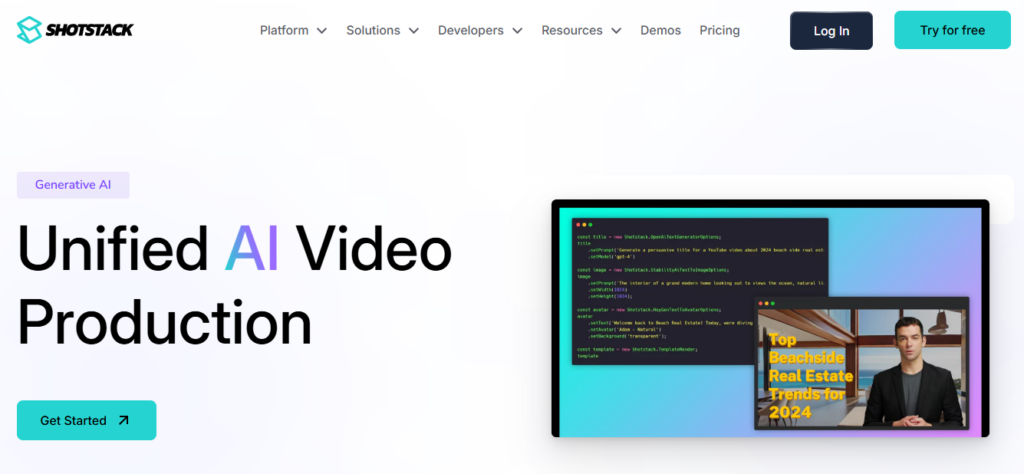
Ans:-Yes. Shotstack supports AI-assisted video creation through its open-source demo workflow that combines OpenAI for script writing and image prompt generation with Shotstack's rendering API to produce faceless short-form videos for TikTok, YouTube Shorts, and Instagram Reels. The workflow generates a voiceover script, six AI image prompts, auto-captions, and assembles everything into a 9:16 MP4 in a single API call.
Q9.Which storage platforms does Shotstack integrate with?
Ans:-Shotstack routes rendered video and image outputs directly to AWS S3, Google Cloud Storage, Mux (for adaptive streaming), TikTok (for direct publishing), and Google Drive — all via built-in integrations configured in your account settings. This eliminates intermediate download-and-re-upload steps in production video pipelines and lets you keep all rendered assets in your own infrastructure.
Q10.What are the main limitations of Shotstack?
Ans:-The main limitations are that 4K resolution output is locked behind the High Volume plan (50,000+ minutes/year), making it inaccessible at affordable price points for smaller teams. Overage on the Subscription plan is charged at a 30% premium to your base rate, which can cause unexpected cost spikes for teams with inconsistent monthly volume. There is also no native social media publishing — rendered videos are delivered to storage or webhook destinations, requiring a separate Make.com, Zapier, or custom integration to post to social platforms.

Promote This Tool

Help others discover this tool by sharing this page.

✓ Link copied to clipboard!

Shotstack Reviews

0.0
Based on 0 reviews
5 star
0%
4 star
0%
3 star
0%
2 star
0%
1 star
0%

Write a Review

Your Rating:

No reviews yet. Be the first to share your thoughts!

42 Similar Shotstack Tools