Home Categories Deals Sign Up
Updated: June 4, 2026

Vapi AI: The Infrastructure Layer for Voice Agent Builders

Vapi AI is a developer-first voice AI infrastructure platform — not a no-code tool, not a pre-packaged call center product, but the orchestration layer that technical teams use to assemble custom voice agents from best-of-breed components: any LLM (OpenAI, Anthropic, Google), any TTS provider (ElevenLabs, Deepgram, Cartesia, LMNT), any STT engine (Deepgram, Gladia, AssemblyAI), and any telephony carrier (Twilio, Telnyx, or BYOC).

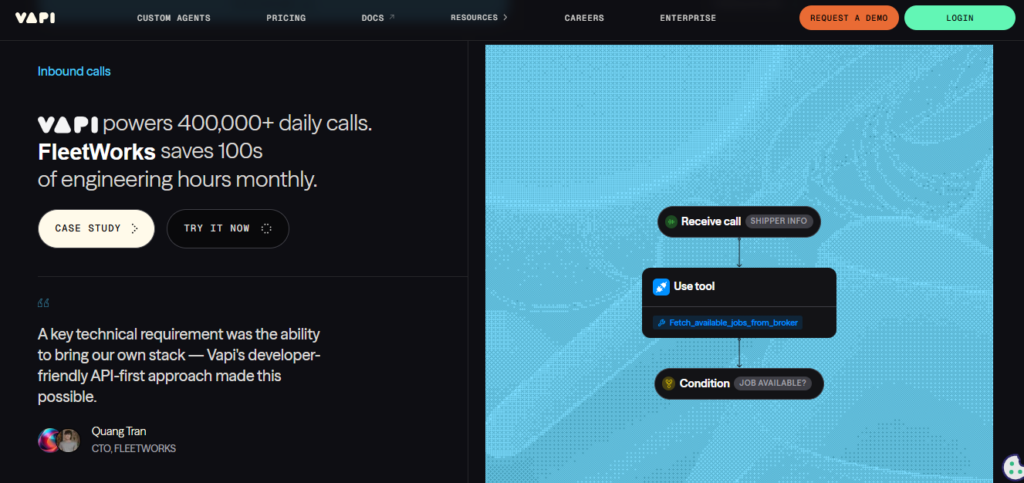
The platform powers 400,000+ daily calls for 225,000+ registered developers — from startups to Fortune 500 companies — and exposes 4,200+ API configuration points that make it the most customizable voice AI platform available today.

Vapi does not build the voice; it orchestrates the pipeline connecting speech to intelligence to speech at sub-600ms latency, at any scale, with built-in compliance certifications for healthcare, fintech, and payment processing environments.

Key Capabilities

Vapi's architecture is built on two core agent primitives: Assistants — single-prompt agents with tools and structured output for standard call automation — and Squads, launched in December 2025, which orchestrate multiple specialized assistants in a single call with context-preserving transfers.

A caller speaks to an intake assistant, gets routed to a scheduling assistant, then transfers to a billing assistant — all within one continuous call session where each specialist picks up exactly where the previous one left off.

Workflows 2.0, a major platform update released in June 2025, replaces single-prompt design with a visual node-based conversation flow builder — enabling builders to map complex conditional logic, variable extraction, dynamic routing, and global nodes visually without sacrificing the prompt-level control that Vapi power users rely on.

The Test Suite enables pre-production simulation of voice agent conversations against user-defined success criteria — automatically detecting hallucination risks, logic failures, and edge case breakdowns before a single live caller experiences them — with independent reviewers confirming the suite enables 95%+ production reliability when used systematically.

Who Gets the Most Out of It

Software engineering teams building voice-first products — IVR replacement, conversational AI apps, real-time voice interfaces in SaaS platforms — use Vapi's BYOK (Bring Your Own API Keys) architecture to plug in their existing OpenAI, Anthropic, Deepgram, and ElevenLabs subscriptions and orchestrate them through Vapi's low-latency pipeline without building and maintaining the plumbing themselves.

AI agencies and freelance automation builders use Vapi's Agency plan ($500/month, packaged minutes, multi-client subaccounts) to manage voice agent deployments for multiple clients simultaneously — building outbound cold callers, appointment setters, and customer support agents integrating Twilio, GoHighLevel, Make.com, Airtable, and Cal.com without writing a voice infrastructure layer from scratch.

Healthcare and fintech organizations use the HIPAA and PCI compliance certifications to deploy patient scheduling agents and payment collection assistants in regulated environments — with Squads enabling selective recording and transcription disabling during sensitive payment collection phases to stay PCI compliant while still capturing call quality data.

Is It Worth It?

The $10 free credit with no commitment is a genuine hands-on evaluation environment — enough for approximately 150–200 minutes of testing at base pricing.

The $0.05/min Vapi orchestration rate is competitive, but the total real-world cost requires honest modeling: add LLM costs ($0.02–$0.07/min), TTS and STT provider fees, and Twilio telephony ($0.02/min) and the all-in rate lands between $0.13 and $0.33/min for most deployments, with enterprise-grade production environments typically requiring $40,000–$70,000/year based on independent cost analyses.

The honest caveat is that Vapi is explicitly built for technical teams — the dashboard is powerful but not beginner-friendly, BYOK setup requires managing multiple third-party accounts simultaneously, and debugging multi-component pipelines demands engineering familiarity.

Businesses wanting a managed, no-code voice agent platform with a single predictable per-minute cost should compare Synthflow AI or Retell AI before committing to Vapi's infrastructure-layer model.

Vapi AI is a developer-first voice AI infrastructure and orchestration platform trusted by 225,000+ developers and powering 400,000+ daily calls for startups to Fortune 500 companies.

It provides the orchestration layer connecting custom STT (Deepgram, Gladia, AssemblyAI), LLM (OpenAI, Anthropic, Google), and TTS (ElevenLabs, Cartesia, LMNT) providers through 4,200+ API configuration points at sub-600ms latency — with two agent primitives (Assistants and Squads), Workflows 2.0 visual flow builder, a built-in Test Suite for pre-launch simulation, built-in hallucination guardrails, 100+ language support, 1,000+ pre-made templates, and SOC 2, HIPAA, and PCI compliance certifications — on a usage-based model starting with $10 free credit and a $0.05/min base platform fee.

• Assistants and Squads — Two Agent Primitives — Assistants are single-system-prompt agents with tools and structured output for standard call flows — customer support, lead qualification, booking, FAQ; Squads orchestrate multiple specialized assistants in a single call with context-preserving transfers — enabling medical triage → scheduling → billing, or e-commerce order → returns → VIP flows, all within one continuous call session where each specialist receives full structured conversation context from the previous agent.

Workflows 2.0 — Visual Conversation Flow Builder — A major June 2025 upgrade replacing single-prompt design with a node-based visual flow builder; map conversation branches, conditional steps, variable extraction, global nodes, call transfer logic, and dynamic routing visually — providing the control of single-prompt design with the scalability of a full workflow system without sacrificing developer-level precision.

• Test Suite and Pre-Launch Call Simulation — Define success criteria per use case, simulate hundreds of conversation scenarios in a controlled environment before any live calls, and automatically identify hallucination risks, logic failures, and edge case breakdowns — with independent YouTube reviewers confirming systematic Test Suite use achieves 95%+ production reliability on live deployments.

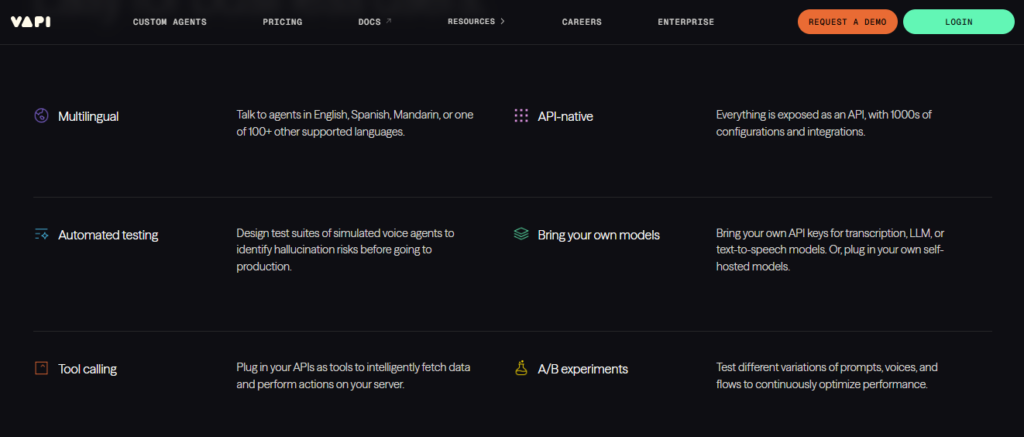
• Bring Your Own Keys (BYOK) — Provider-Agnostic Architecture — Plug in your own API keys for any STT provider (Deepgram, Gladia, AssemblyAI), any LLM (OpenAI GPT-4.1, Anthropic Claude, Google Gemini, self-hosted models), and any TTS provider (ElevenLabs, Cartesia, LMNT, Deepgram Aura) — enabling teams to use existing provider relationships, negotiate volume pricing independently, and maintain full control over the AI stack Vapi orchestrates.

• Built-In Hallucination Guardrails — Conversation guardrails embedded in the Vapi orchestration layer prevent model hallucinations and ensure data integrity across all assistant types — operating at the infrastructure level rather than relying solely on LLM-level instruction compliance, providing a safety net that survives prompt engineering edge cases.

• 4,200+ API Configuration Points — Every parameter of the voice agent pipeline is exposed as an API endpoint — latency thresholds, interruption sensitivity, silence detection, turn-taking behavior, endpointing detection, backchannel audio, custom vocabulary, SSML injection, webhook triggers, and hundreds more — enabling teams to tune voice agent behavior with a precision no low-code platform provides.

• SOC 2, HIPAA, and PCI Compliance — SOC 2 on Enterprise, HIPAA for healthcare deployments, and a dedicated PCI Compliance mode that uses Squads to selectively disable recording, logging, and transcription during payment collection phases while maintaining call quality audit capability on non-sensitive call segments — confirmed in official Vapi documentation.

• Scalable Infrastructure — Sub-600ms Latency at Enterprise Volume — Custom real-time audio infrastructure scales from single-agent testing to millions of simultaneous calls in minutes; ultra-low latency confirmed at sub-400ms in independent reviewer tests; round-the-clock monitoring and multi-region infrastructure with dedicated forward-deployed engineer support on Enterprise plans for teams that need to go live in one week.

Pros
  • 225,000+ registered developers and 400,000+ daily calls — the largest confirmed developer user base and highest daily call volume in this review series, representing more real-world production validation than any competing platform
  • 4,200+ API configuration points is the most granular voice agent configuration surface of any platform in this review series — enabling technical teams to tune every parameter of latency, turn-taking, hallucination guardrails, interruption sensitivity, and audio processing with precision that no managed platform can match
  • Bring Your Own Keys (BYOK) for STT, LLM, and TTS providers gives full control over the AI stack — technical teams use existing provider relationships, negotiate volume discounts independently, and avoid being locked into Vapi's vendor selections
  • Squads multi-agent orchestration with context-preserving transfers — launched December 2025 — enables genuinely complex multi-specialist call flows that single-prompt assistants cannot handle at scale, solving the architectural problem that causes most voice AI deployments to fail as complexity grows
  • Test Suite pre-launch simulation with auto-detected hallucination risks and logic failures is the most developer-native quality assurance tool in this review series — enabling systematic 95%+ reliability before any live caller hears the agent
  • SOC 2, HIPAA, and PCI compliance with a dedicated PCI Compliance mode using Squads for selective recording disabling — the only platform in this review series with a formally documented PCI-compliant call architecture for payment data collection scenarios
  • Free $10 starting credit with no subscription commitment provides approximately 150–200 minutes of hands-on testing for genuine technical evaluation before any financial commitment
Cons
  • ×True all-in cost is $0.13–$0.33/min when stacking LLM, STT, TTS, and telephony fees on top of the $0.05/min base — the gap between the advertised rate and the real-world cost is the most frequently cited complaint in G2, Reddit, and independent review sources, and enterprise environments regularly require $40,000–$70,000/year in total spend
  • ×Explicitly designed for technical teams — non-developers, solo operators, and small businesses without engineering resources will struggle with BYOK setup, multi-provider debugging, Vapi dashboard configuration, and API-level troubleshooting that competitors like Synthflow handle with no-code visual builders
  • ×No in-house telephony — Vapi relies entirely on third-party telephony (Twilio, Telnyx, BYOC) and has no owned network infrastructure; uptime and latency guarantees depend on the SLAs of external carriers rather than Vapi's own commitments
  • ×No in-house TTS or STT engines — voice quality is entirely dependent on the ElevenLabs, Deepgram, Cartesia, or LMNT subscription the user brings in; buyers expecting a ready-to-use voice out of the box must set up and pay for a separate TTS provider account before their first call works
  • ×Agency plan at $500/month is a significant step above PAYG for builders managing multiple client accounts — teams needing multi-client subaccount management at smaller volumes have no mid-tier option between PAYG and the $500/month Agency plan
  • ×Billing complexity with six stacked cost components — platform fee, LLM API, TTS provider, STT provider, telephony, and optional add-ons — requires engineering-level cost modeling to avoid budget surprises; multiple independent reviewers flag unexpected invoice spikes during campaign surges as a recurring operational risk

Vapi AI is purpose-built for technical teams and developer-led organizations who want maximum configurability and infrastructure control over their voice agent stack — not managed-service buyers.

• Software engineering teams building voice-first products — Use Vapi's BYOK architecture and 4,200+ API configuration points to integrate best-of-breed LLM, STT, and TTS providers into a custom low-latency voice pipeline without building the orchestration infrastructure from scratch.

• AI agencies and automation builders — Use the Agency plan ($500/month, packaged minutes, multi-client subaccounts) to build and manage outbound cold callers, appointment setters, and customer support agents for multiple clients using Make.com, GoHighLevel, Airtable, and Cal.com integrations.

• Healthcare technology teams — Deploy HIPAA-certified patient scheduling, triage routing, and appointment reminder agents using Squads for multi-specialist call flows — medical triage to scheduling to billing — with context preservation and selective recording compliance.

• Fintech and payment platforms — Use PCI Compliance mode with Squads to selectively disable recording during payment data collection phases while maintaining call quality audit coverage on non-sensitive call segments — the only confirmed PCI-compliant voice architecture in this review series.

• Enterprise engineering teams replacing IVR infrastructure — Migrate legacy IVR systems to Vapi-powered voice agents using BYOC telephony (keep existing carrier relationships) and BYOK LLM/TTS (keep existing AI contracts) with Vapi providing only the orchestration layer that the legacy system could not.

Free ($10 credit, no commitment)Approximately 150–200 minutes of testing at base pricing — covers Vapi orchestration only; LLM, TTS, STT, and telephony costs are billed separately via your own provider accounts or Vapi-managed services.
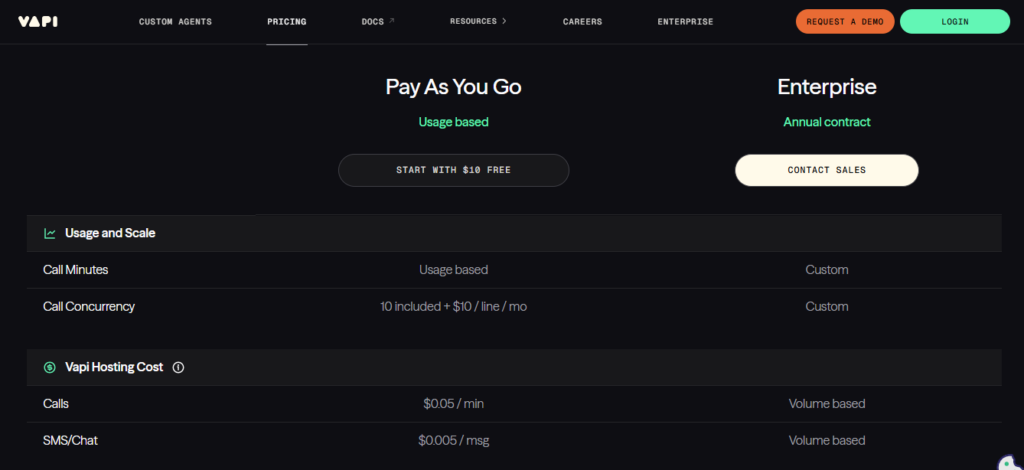
Pay-As-You-Go$0.05/min Vapi platform fee + stacked costs:
• LLM (examples)GPT-4o mini ~$0.02/min, GPT-4.1 ~$0.05/min, GPT-4o ~$0.07/min
• TTS provider (ElevenLabs, Cartesia, etc.)~$0.02–$0.05/min
• STT provider (Deepgram, Gladia, etc.)~$0.01–$0.03/min
• Telephony (Twilio/Telnyx managed)~$0.02/min; BYOC: $0.00/min
• Realistic all-in range$0.13–$0.33/min depending on provider selection
• Concurrent call limit10 calls on PAYG
Agency Plan ($500/month)Packaged minutes included, shared resource allocation, multi-client subaccount management, additional dashboard features, limited support — for agencies managing multiple client voice agent deployments.
Startup Plan ($999.98/month)Packaged minutes, reduced variable rates, added dashboard features, limited support — for growing teams with established production call volumes.
Enterprise (Custom — contact sales)Custom volume pricing and SLAs, unlimited concurrent calls, SOC 2 compliance, HIPAA certification, PCI Compliance mode, dedicated support channels (shared Slack, direct engineering access), deployment assistance with a forward-deployed engineer targeting go-live in one week, custom API rate limits, and early access to new features — recommended for $40,000–$70,000+/year total deployment budgets.

Vapi's competitive position is defined entirely by engineering depth and configurability — it is the infrastructure platform for builders who have outgrown every managed voice agent platform they've tried.

• 4,200+ API Configuration Points — The Most Configurable Voice AI Platform Available — No other platform in this review series confirms 4,200+ exposed API configuration points. Every parameter of the conversation pipeline is independently adjustable: endpointing detection thresholds, backchannel audio behavior, interruption sensitivity, silence detection, custom vocabulary injection, SSML control, per-turn latency targets, webhook trigger conditions, and hundreds of behavioral parameters that determine whether a voice agent sounds robotic or human in edge cases. For technical teams tuning agents for specific environments — noisy factory floors, accented speakers, emotionally charged support calls — this depth is the difference between a reliable agent and one that breaks unpredictably.

• Squads — Context-Preserving Multi-Agent Call Architecture — Squads are architecturally distinct from simple call transfers. When a Vapi Squad transfers a caller between assistants, it passes a granular context payload — extracted variables, conversation state, qualification flags, intent tags — that the receiving assistant uses to continue seamlessly. Competitors that offer warm transfer typically pass a transcript summary. Squads pass structured data, enabling the receiving assistant to ask the right next question rather than re-establishing context. This is particularly significant for PCI Compliance mode where Squads' context control enables selective recording disabling during payment phases — a use case no other platform in this review series documents with this architectural precision.

• BYOK Architecture Across All Three Pipeline Components Simultaneously — Vapi allows bringing your own API keys for STT, LLM, and TTS providers independently — meaning a team can run Deepgram STT, Anthropic Claude LLM, and Cartesia TTS simultaneously in one Vapi pipeline. No other platform in this review series offers bring-your-own keys across all three pipeline components at once with this level of granular per-component provider selection.

• Test Suite with Automated Hallucination Risk Detection — Vapi's Test Suite goes beyond simple conversation simulation by automatically scoring agent responses against defined success criteria and flagging hallucination risks before production exposure. The detection happens at the test stage — not just the guardrails layer in production — meaning teams catch problems before customers experience them rather than detecting them reactively through post-call QA. Independent YouTube reviewers confirm this enables 95%+ production reliability when applied systematically across a full scenario library.

• Vapi CLI — Terminal-Native Platform Access — Vapi provides a dedicated CLI that exposes the full platform in the terminal: create assistants, manage phone numbers, trigger calls, retrieve transcripts, and configure squads without touching the dashboard. For developer teams that live in the terminal and treat the dashboard as a fallback, this is a workflow integration that competing platforms including Synthflow, LOVO, and ElevenLabs do not confirm.

Vapi AI's BYOK architecture makes it the most broadly compatible voice AI platform in this review series — integrating with the full developer ecosystem across LLMs, voice providers, telephony, and automation tools.

• LLM Providers (BYOK) — OpenAI (GPT-4o, GPT-4.1, GPT-4.1 mini, GPT-5 series), Anthropic (Claude 3.5 Sonnet, Claude 3 Opus), Google (Gemini 1.5 Pro, Gemini 2.0 Flash), and self-hosted models via custom endpoint — configure any model as the conversation brain with per-assistant model selection and temperature tuning inside Workflows 2.0.

• TTS and STT Providers (BYOK) — TTS: ElevenLabs, Cartesia, LMNT, Deepgram TTS, Azure TTS, and more; STT: Deepgram Nova, Gladia, AssemblyAI — bringing your own API keys for any provider combination means no vendor lock-in and independent volume pricing negotiation.

• Telephony Carriers — Twilio (Vapi-managed or BYOK), Telnyx (BYOK), and Bring Your Own Carrier (BYOC) via SIP trunking — compatible with any SIP-based telephony infrastructure; 100+ language support across all carrier configurations; BYOC enables enterprises to keep existing carrier relationships and pricing.

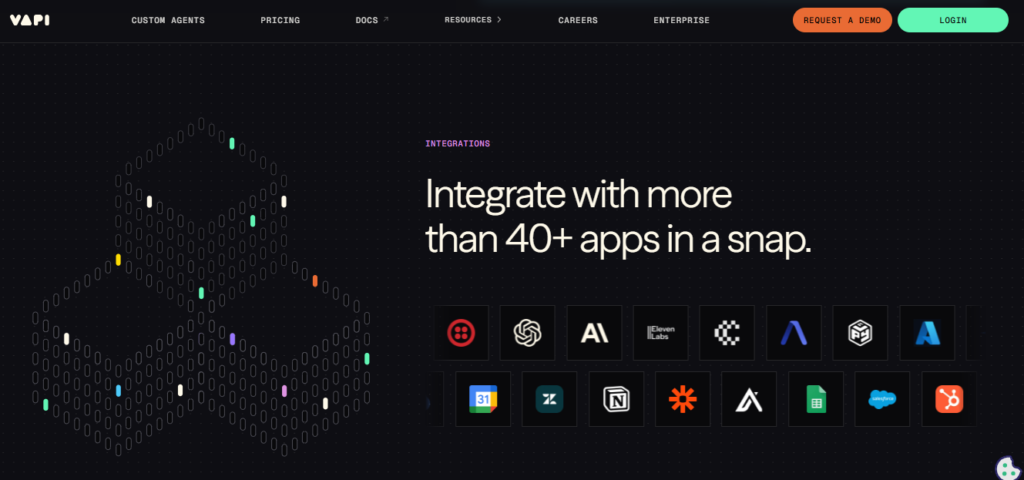
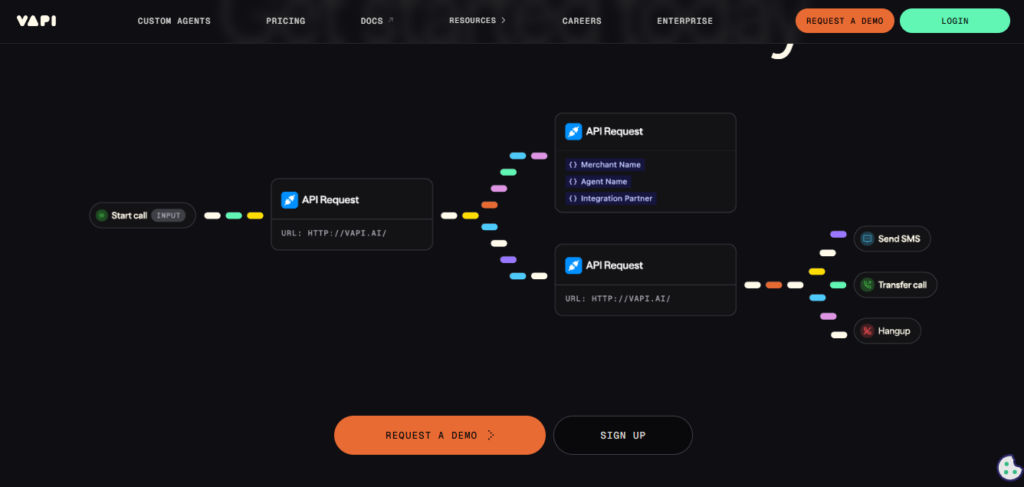
• Automation and CRM Integrations — GoHighLevel (confirmed in multiple YouTube tutorials and case studies), Make.com, n8n, Zapier, Airtable, Google Sheets, HubSpot, Salesforce, Calendly, Cal.com, Google Calendar — connected via Vapi's custom tool system where any REST API endpoint can be registered as a callable tool inside an assistant or squad workflow.

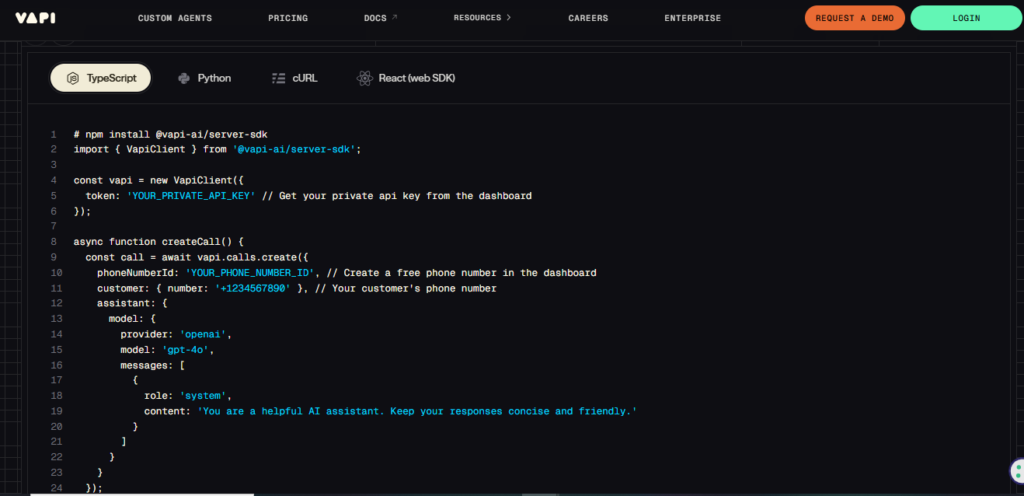
• Developer SDKs and CLI — JavaScript/TypeScript and Python SDKs for programmatic agent creation, call initiation, transcript retrieval, and squad management; Vapi CLI for terminal-native full platform access; REST API with webhook support for downstream system triggers — designed for embedding Vapi into SaaS products, mobile apps, and enterprise backend systems without UI dependency.

CategoryScoreWhy It Matters
Accuracy & Reliability4.7/5400,000+ daily calls across 225,000+ developers with sub-600ms latency confirmed in independent reviewer tests — the highest daily call volume in this review series, implying infrastructure reliability at proven production scale. Built-in conversation guardrails prevent model hallucinations at the orchestration layer rather than relying solely on prompt engineering. The Test Suite enables systematic pre-launch reliability validation that independent reviewers confirm achieves 95%+ production success rates. Deductions apply for the absence of a published uptime SLA on PAYG plans and the latency dependence on third-party telephony carriers rather than owned network infrastructure.
Ease of Use3.6/5For technical users, Vapi's Workflows 2.0 visual builder, 1,000+ templates, CLI, and comprehensive API documentation represent a well-designed developer experience — Product Hunt reviewers give it 4.9/5 and G2 reviewers cite easy integration and smooth setup. For non-technical users, the platform's BYOK setup requiring multiple separate provider accounts, billing complexity with six stacked cost components, and absence of managed end-to-end onboarding creates a steep learning curve. G2 reviewers explicitly note 'I have to be a developer if I want to understand all the options.' The 3.6 score reflects the bimodal experience: excellent for developers, actively hard for non-developers.
Functionality & Features4.9/5The confirmed live feature set is the deepest technical voice agent platform in this review series: 4,200+ API config points, Assistants and Squads multi-agent orchestration, Workflows 2.0 visual builder, Test Suite with hallucination risk detection, BYOK for STT/LLM/TTS, built-in conversation guardrails, 100+ languages, 1,000+ templates, PCI Compliance mode with selective recording via Squads, HIPAA certification, SOC 2, Vapi CLI, JavaScript/Python SDKs, and custom tool integration for any REST API. No other platform in this review series confirms comparable feature depth at the developer infrastructure layer.
Performance & Speed4.7/5Sub-600ms latency documented in official docs with sub-400ms confirmed in independent reviewer tests — competitive with the fastest platforms in this review series. Custom real-time audio infrastructure with enterprise-grade reliability and round-the-clock monitoring. Enterprise plan includes a forward-deployed engineer guaranteeing go-live in one week — the fastest confirmed enterprise deployment timeline in this review series. Deductions apply for the lack of an in-house telephony layer meaning latency and uptime performance partially depends on third-party carrier infrastructure Vapi does not own, and occasional multi-second hang spikes reported in public forums and review platforms.
Customization & Flexibility5.0/54,200+ API configuration points, BYOK for all three pipeline components simultaneously, Squads context-passing architecture, Workflows 2.0 with granular node-level control, PCI Compliance selective recording via Squads, self-hosted model support, BYOC for telephony, custom vocabulary injection, per-turn behavior tuning, and CLI access — collectively the most granular voice AI customization surface confirmed in this review series by a significant margin. No other platform approaches Vapi's configuration depth, making it the only 5.0/5 score in this category.
Data Privacy & Security4.7/5SOC 2, HIPAA, and PCI compliance confirmed in official documentation — with PCI Compliance mode's Squads-based selective recording architecture being the most technically sophisticated payment data protection implementation confirmed in this review series. BYOK architecture means sensitive data flows directly between customer provider accounts and callers without passing through Vapi's managed storage for AI inference components. Deductions apply for the absence of confirmed ISO 27001 and GDPR certifications on the official site — relevant for European enterprise buyers and regulated-market deployments outside healthcare and fintech.
Support & Resources4.4/5Official Vapi AI YouTube channel with Squads Launch Webinar, Workflows 2.0 Complete Guide, Test Suite tutorials, and regular feature videos. 13,000+ documented support topics — the most extensive support knowledge base confirmed in this review series. A developer Discord community with active engagement from the Vapi engineering team. Enterprise plans include dedicated shared Slack channels with direct engineering access and a forward-deployed engineer for onboarding. Deductions apply for PAYG and Agency plan users who receive documentation-only support without direct human access, and for the absence of a public community forum for non-enterprise builders outside Discord.
Cost-Efficiency3.9/5The $0.05/min platform fee is a genuinely competitive charge for avoiding the non-trivial engineering work of building real-time audio orchestration infrastructure — confirmed by Zeeg's independent analysis as reasonable for its infrastructure value. The $10 free credit and zero-subscription PAYG entry point make Vapi accessible for pilots without financial commitment. Deductions apply for the stacked true all-in cost of $0.13–$0.33/min being significantly higher than the advertised base rate — the most frequently cited complaint in public reviews — and for enterprise deployments requiring $40,000–$70,000/year, making it a high-cost platform for organizations that don't extract the full value from its configurability.
Overall Score4.5/5Vapi AI is the definitive developer infrastructure platform for voice agent builders in 2026 — the most configurable voice AI system in this review series with 4,200+ API config points, BYOK for all three pipeline components, Squads multi-agent orchestration, and the only PCI-compliant call architecture documented with selective recording precision. It earns deductions for the non-developer accessibility gap, the stacked billing complexity, the absence of owned telephony infrastructure, and the opaque true cost delta between the $0.05/min base rate and the $0.13–$0.33/min real-world all-in rate. For technical teams building production voice AI at scale, Vapi is the benchmark platform in this series.

Vapi AI is the benchmark developer infrastructure platform for voice agent builders in 2026 — 225,000+ developers, 400,000+ daily calls, 4,200+ API configuration points, Squads multi-agent orchestration, Workflows 2.0, a pre-launch Test Suite with hallucination risk detection, BYOK for all three pipeline components, and SOC 2 / HIPAA / PCI compliance.

It is the right platform for engineering teams, AI agencies, and enterprise technical buyers who want maximum configurability and control over their voice AI stack and are comfortable modeling the true all-in cost of $0.13–$0.33/min.

Non-technical teams, small businesses, and buyers who want a single predictable per-minute cost with managed infrastructure should compare Synthflow AI first — Vapi's power comes with genuine operational complexity that non-developers will struggle to manage effectively.

Q1.What is Vapi AI and how does it work?
Ans:-Vapi AI is a developer-first voice AI infrastructure platform that acts as the orchestration layer connecting speech-to-text, large language models, and text-to-speech providers into a real-time voice conversation pipeline at sub-600ms latency. It powers 400,000+ daily calls for 225,000+ developers. You bring your own API keys for any STT, LLM, or TTS provider you prefer — Vapi handles the real-time audio routing, turn-taking logic, latency optimization, telephony integration, and conversation management between them, so your team builds the agent behavior rather than the infrastructure.
Q2.What is the difference between Vapi Assistants and Squads?
Ans:-Assistants are single-system-prompt voice agents — the standard building block for most call automation: customer support, lead qualification, FAQ handling, appointment booking. One prompt, one agent, one call flow. Squads, launched December 2025, orchestrate multiple specialized Assistants within a single call with context-preserving transfers — meaning a caller can speak to an intake assistant, get routed to a scheduling assistant, and transfer to a billing assistant all in one call, with each specialist receiving full structured context from the previous agent. Squads are designed for multi-step workflows that break down when stuffed into a single prompt.
Q3.How much does Vapi AI actually cost per minute?
Ans:-Vapi's base platform fee is $0.05/min for orchestration — but this is not the all-in cost. On top of the base fee, you pay separately for: your LLM (GPT-4.1 ~$0.05/min, GPT-4o mini ~$0.02/min), your TTS provider (~$0.02–$0.05/min via ElevenLabs or Cartesia), your STT provider (~$0.01–$0.03/min via Deepgram), and telephony (~$0.02/min Twilio, or $0.00/min if you bring your own carrier). Most real-world deployments land between $0.13 and $0.33/min all-in. Enterprise production environments typically require $40,000–$70,000/year in total spend based on independent cost analyses.
Q4.Is Vapi AI free to use?
Ans:-Vapi provides $10 in free credit to all new accounts with no credit card required — enough for approximately 150–200 minutes of base-rate testing. This covers the $0.05/min Vapi orchestration fee only. To make actual voice calls, you also need to connect STT, LLM, and TTS provider accounts (which have their own free tiers depending on the provider) and a telephony number ($1.50 from Vapi or BYOC). The $10 credit is a genuine technical evaluation environment — sufficient for building and testing several voice agent flows before making any financial commitment.
Q5.What is the Vapi Test Suite?
Ans:-The Test Suite is Vapi's pre-production voice agent testing system. You define success criteria for your use case — correct data extraction, appropriate transfer triggers, valid booking responses — and run simulated conversation scenarios against your assistant before any live callers interact with it. The Test Suite automatically identifies hallucination risks (where the agent fabricates information), logic failures (wrong branch taken), and edge case breakdowns. Independent YouTube reviewers confirm systematic Test Suite use achieves 95%+ production reliability — making it the most important quality gate in the Vapi deployment workflow.
Q6.Does Vapi AI support HIPAA and PCI compliance?
Ans:-Yes. HIPAA compliance is available on Vapi's Enterprise plan for healthcare deployments handling protected health information (PHI). PCI Compliance is available as a dedicated toggle in assistant settings — when enabled, it disables call recording, logging, and transcription to prevent payment card data from being stored in Vapi's systems. Using Squads with PCI Compliance mode, you can selectively disable recording only during the payment collection phase of a call while keeping recording enabled for the rest, retaining quality audit capability on non-sensitive call segments. SOC 2 compliance is confirmed on the Enterprise plan.
Q7.What is Vapi Workflows 2.0?
Ans:-Workflows 2.0 is a major platform upgrade released in June 2025 that replaces single-prompt agent design with a visual node-based conversation flow builder. Instead of cramming all conditional logic into a single system prompt — which becomes brittle at scale — you map the conversation visually: Conversation Nodes for dialogue steps, Condition Steps for branching logic, Variable Extraction nodes for capturing data during calls, Global Nodes for behaviors that apply across the entire flow (like escalation to a human), and Call Transfer nodes for routing to other assistants or external numbers. The result is agents with more complex logic that are easier to debug, test, and iterate.
Q8.What does BYOK mean in Vapi and why does it matter?
Ans:-BYOK stands for Bring Your Own Keys — it means you supply your own API keys for the STT, LLM, and TTS providers Vapi orchestrates, rather than paying Vapi for managed provider access. This matters for three reasons: first, you can use any combination of best-of-breed providers independently (Deepgram for STT, Anthropic Claude for LLM, ElevenLabs for TTS); second, you negotiate volume pricing directly with each provider and aren't locked into Vapi's managed rates; third, your data flows directly between your provider accounts and the caller with Vapi only handling the orchestration layer — relevant for teams with existing enterprise agreements with specific AI providers.
Q9.How does Vapi AI compare to Synthflow AI?
Ans:-The fundamental difference is the builder profile each platform targets. Vapi is developer infrastructure — maximum configurability, BYOK for all providers, 4,200+ API config points, CLI access, and a pricing model that requires engineering-level cost modeling. Synthflow is an enterprise managed platform — no-code Flow Designer, owned telephony with 99.99% uptime SLA, BELL Framework lifecycle system, and a single transparent pricing structure. Vapi wins for teams that want full stack control and are comfortable managing multi-vendor pipelines. Synthflow wins for enterprise buyers who want predictable pricing, managed infrastructure, and HIPAA compliance without assembling a multi-vendor stack.
Q10.Can non-technical users build voice agents on Vapi?
Ans:-Vapi provides 1,000+ pre-made agent templates that reduce the starting point — and the Workflows 2.0 visual builder reduces dependency on single-prompt engineering. Multiple YouTube tutorials confirm non-developers completing basic voice agents in under 25 minutes using the dashboard. However, for production-grade deployments — BYOK setup, multi-provider debugging, Squads configuration, API rate troubleshooting, and cost modeling across six billing components — Vapi consistently requires engineering familiarity. Non-technical operators who need managed infrastructure without multi-tool orchestration should evaluate Synthflow AI or Retell AI as more appropriate alternatives.

Promote This Tool

Help others discover this tool by sharing this page.

✓ Link copied to clipboard!

Vapi AI Reviews

0.0
Based on 0 reviews
5 star
0%
4 star
0%
3 star
0%
2 star
0%
1 star
0%

Write a Review

Your Rating:

No reviews yet. Be the first to share your thoughts!

48 Similar Vapi AI Tools