Record, edit, dub, subtitle, generate AI video, clone your voice, and publish — one AI platform where video, sound, and voice connect, starting free.
Vapi AI
Build custom, real-time AI voice agents for calls.
In an increasingly digitized world, the human voice remains a powerful and intuitive interface for communication. Businesses are constantly seeking innovative ways to scale their customer interactions, automate repetitive tasks, and deliver personalized experiences without compromising on quality or responsiveness.
Traditional voice automation, often characterized by rigid IVR systems and robotic voices, has long fallen short of modern expectations, leading to frustrating customer journeys and operational inefficiencies. The emergence of advanced conversational AI, powered by Large Language Models (LLMs) and sophisticated speech technologies, has opened new frontiers for intelligent voice interactions.
However, harnessing this power often demands deep technical expertise, requiring developers to stitch together various complex components: speech-to-text (STT), natural language processing (NLP), text-to-speech (TTS), and telephony infrastructure. This is precisely where Vapi AI steps in.
As verified from its official website and corroborated by comprehensive industry research from 2025, Vapi AI's PRIMARY FUNCTION is to serve as a developer-focused platform for building, testing, and deploying real-time AI voice assistants for phone calls.
It is specifically engineered to provide granular control and flexibility over the entire AI voice stack, making it an indispensable tool for developers, engineering teams, and businesses that prioritize customizability, performance, and seamless integration into their existing systems. This Vapi AI review will embark on a detailed exploration of the platform, examining its core purpose, extensive features, and ideal user base.
We will dissect how Vapi AI orchestrates real-time voice conversations, its unique multi-model AI support (allowing users to “Bring Your Own” keys for leading LLMs and TTS providers), its intuitive Flow Studio, and its robust capabilities for tool calling, webhook routing, and even agent chaining (Squads) for highly complex scenarios.
We will objectively assess its distinct advantages and limitations, provide practical use cases, and compare it against notable alternatives like Synthflow AI, Voiceflow AI, and Voicegenie AI.
What is Vapi AI?
Vapi AI is a cutting-edge, developer-centric platform that provides the essential infrastructure for creating, managing, and scaling real-time AI voice assistants for phone calls. Unlike many “no-code” or “low-code” solutions that prioritize simplicity over flexibility, Vapi AI puts the power of granular control directly into the hands of developers and engineering teams.
Its primary function, as prominently highlighted on its official website, is to abstract away the significant complexities involved in building a low-latency, highly responsive voice AI stack, allowing developers to focus on conversational logic and integration.
At its core, Vapi AI orchestrates the intricate dance between several AI components in real-time:
- Speech-to-Text (STT): Transcribing spoken words into text with minimal latency.
- Large Language Models (LLMs): Processing the transcribed text to understand intent, generate responses, and manage conversational flow.
- Text-to-Speech (TTS): Converting the LLM's text responses back into natural-sounding speech.
- Telephony Infrastructure: Connecting the AI assistant to the public switched telephone network (PSTN) for inbound and outbound calls.
Vapi AI’s infrastructure is built to ensure ultra-low latency, critical for natural-feeling phone conversations, often achieving sub-500ms voice-to-voice response times. This responsiveness is key to preventing awkward pauses and maintaining engaging dialogues.
Key functionalities of the platform, as verified from its official website and corroborated by detailed industry reviews from 2025, include:
Real-time Voice Orchestration: Vapi AI intelligently manages the entire lifecycle of a voice conversation, from capturing audio and transcribing it, to processing it with an LLM, generating a voice response, and playing it back, all in milliseconds. This is a complex technical challenge that Vapi handles seamlessly.
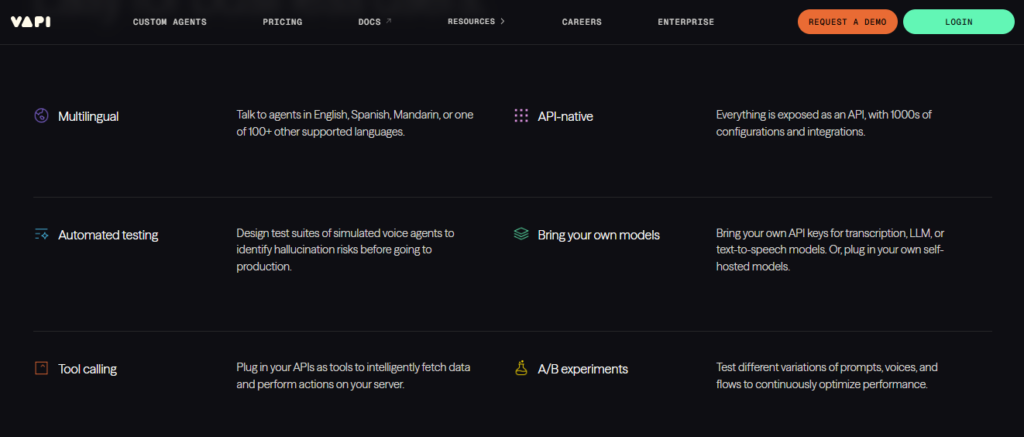
Multi-Model AI Support (Bring Your Own Keys): This is a standout feature for developers. Vapi AI is agnostic to the underlying AI models, allowing users to “Bring Your Own” (BYO) API keys for their preferred STT, LLM, and TTS providers. This includes:
- LLMs: OpenAI (GPT-3.5, GPT-4o), Anthropic (Claude), Google (Gemini), Llama, and more.
- TTS: ElevenLabs, PlayHT, Deepgram, and others, enabling diverse voice options and quality.
- STT: Deepgram, Whisper, etc., for highly accurate transcription. This flexibility allows teams to optimize for cost, performance, and specific language model capabilities, tailoring the AI agent precisely to their needs.
Flow Studio (Visual Builder for Conversational Logic): While developer-focused, Vapi AI offers a visual interface for designing conversational flows.
- Intuitive UI for Logic: The Flow Studio allows users to visually map out conversational paths, defining prompts, responses, and actions. This visual approach simplifies agent design, even for complex interactions.
- JSON Configuration: For more advanced users and intricate logic, Vapi agents can be fully configured via JSON, offering maximum programmatic control and integration with version control systems.
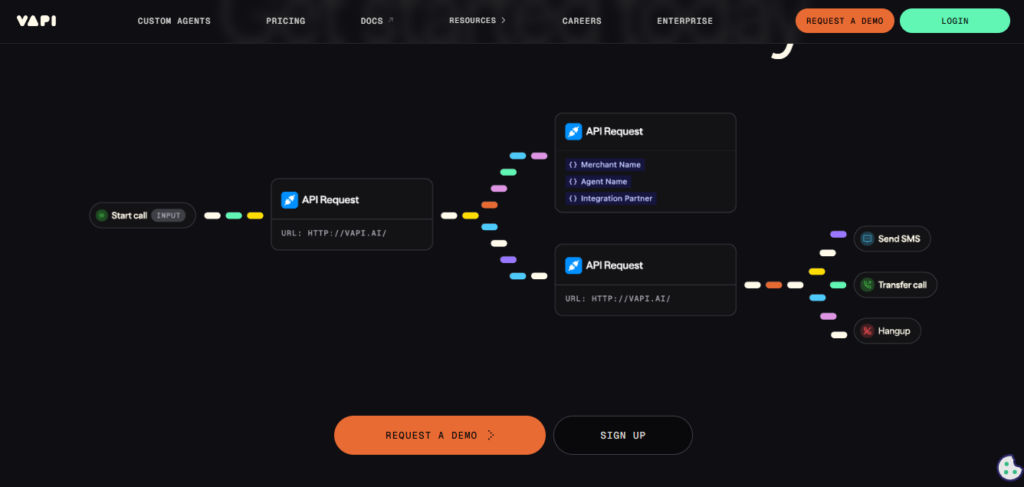
Tool Calling & Webhook Routing: A crucial feature for making AI agents truly useful by connecting them to external systems.
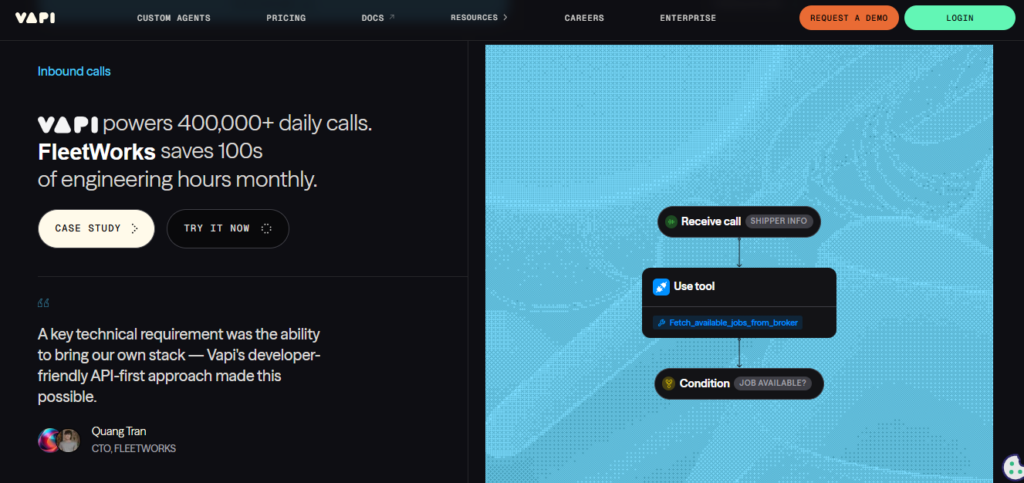
- Backend Action Integration: AI agents can perform actions by calling external tools or APIs (e.g., fetching data from a CRM, initiating a payment, sending an email) based on conversational cues.
- Webhook Support: Vapi AI can send real-time data and events via webhooks to a user's backend, allowing custom logic and integrations to be triggered during or after a call. This is vital for dynamic, data-driven interactions.
Agent Chaining (Squads) for Complex Flows: For highly sophisticated use cases, Vapi allows for multiple AI agents to collaborate.
- Multi-Agent Coordination: Agents can “hand off” conversations to other specialized agents within a larger system, enabling complex, multi-turn, and multi-domain interactions.
- Improved Scalability & Specialization: This architecture allows for modularity, where different agents handle different aspects of a conversation, improving efficiency and manageability.
Multilingual & Global Telephony: Vapi AI supports a wide range of languages and global phone number capabilities.
- 100+ Languages: The platform boasts support for over 100 languages, making it suitable for international deployments and diverse customer bases.
- Telephony Integration: Connects with telephony providers like Twilio and Vonage for robust inbound and outbound call management, including provisioning new numbers or importing existing ones.
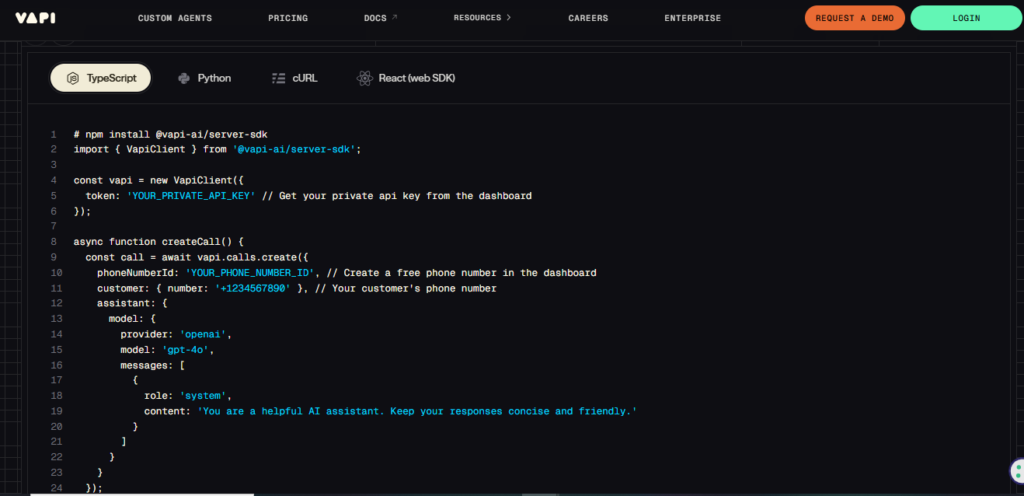
Robust SDKs and API Access: Vapi AI is designed with developers in mind, offering comprehensive tools for programmatic interaction.
- Client & Server SDKs: Provides SDKs for various environments (e.g., TypeScript, Python, Node.js, React, Flutter, iOS) to simplify integration into existing applications.
- REST API: A well-documented REST API allows full programmatic control over agents, calls, logs, and settings.
Real-time Analytics & Call Logs: Provides data on call performance, agent interactions, and conversation transcripts. While some reviews suggest opportunities for deeper insights out-of-the-box, it offers essential data for monitoring and optimizing agent behavior.
Compliance & Security: Vapi AI emphasizes strong security protocols and compliance certifications like HIPAA and SOC 2, crucial for sensitive data handling and regulated industries.
Scalability: Built on a robust Kubernetes cluster, Vapi AI is designed to handle high volumes, boasting the capability to support over 1 million concurrent calls.
Vapi AI positions itself as the foundational layer for developers to build the next generation of highly intelligent, real-time voice applications.
How to Use Vapi AI Tutorial
Pros and Cons Vapi AI
Top 5 Key Features Vapi AI
Real-Time Voice Orchestration with Multi-Model AI Support: This is the cornerstone of Vapi AI's offering, providing the fundamental capability for highly responsive and customizable conversational agents.
- Seamless Integration of Components: Vapi AI effectively manages the complex real-time interplay between Speech-to-Text (STT), Large Language Models (LLMs), and Text-to-Speech (TTS). This orchestration minimizes latency, making conversations flow naturally and avoiding awkward delays common in less sophisticated systems.
- “Bring Your Own” (BYO) Keys for Ultimate Control: Developers can integrate their preferred LLMs (e.g., OpenAI's GPT-4o, Anthropic's Claude 3.5, Google's Gemini), TTS providers (e.g., ElevenLabs for hyper-realistic voices, PlayHT), and STT engines (e.g., Deepgram for superior accuracy). This flexibility allows teams to select the best-in-class models for specific use cases, optimize for cost, and maintain data sovereignty if needed by using their own API keys.
- Performance Optimization: The ability to swap out models means teams can fine-tune the balance between voice quality, transcription accuracy, LLM intelligence, and overall latency to meet specific application requirements.
- Example: An engineering team wants to build a highly intelligent financial advisor AI. They choose GPT-4o for its complex reasoning capabilities, combine it with ElevenLabs for a professional, trustworthy voice, and Deepgram for highly accurate transcription of financial jargon. Vapi AI seamlessly orchestrates these components for a fluid conversation.
Flow Studio (Visual Builder) & JSON Configuration for Conversational Logic: Vapi AI provides both a visual interface and a programmatic approach to defining AI agent behavior, catering to different levels of user expertise.
- Intuitive Visual Design: The Flow Studio offers a drag-and-drop interface where users can visually design the conversational paths, define system prompts, user intent recognition, and the actions the AI should take at each step. This makes basic agent creation accessible and speeds up initial prototyping.
- Advanced JSON Customization: For complex scenarios, Vapi AI agents can be entirely configured using JSON, providing developers with maximum programmatic control. This allows for intricate logic branching, dynamic prompt engineering, and precise control over agent behavior that might be difficult to achieve solely through a visual builder. It also facilitates version control and collaborative development.
- Example: A developer uses the Flow Studio to set up the initial greeting and basic FAQs for a customer support bot. For a more complex scenario, like handling a refund request that requires multiple API calls and conditional logic, they switch to JSON configuration to define precise steps, error handling, and data extraction parameters.
Tool Calling, Webhook Routing, and Backend Integrations: This feature transforms a conversational AI into an actionable assistant by allowing it to interact with external systems.
- Function Calling: Vapi AI agents can execute specific actions by calling external APIs or “tools” based on the user's spoken intent. This enables the AI to perform tasks like looking up order statuses, booking appointments, fetching data from a CRM, or initiating payments.
- Real-time Webhook Events: Vapi AI can send real-time data about the conversation (e.g., call start/end, detected intent, extracted entities) via webhooks to a user's backend. This allows developers to trigger custom business logic, update databases, or initiate workflows in other applications during or after a call.
- Seamless Data Exchange: This robust integration capability means the AI agent is not just a conversational interface but an active participant in a business's operational workflows.
- Example: A sales AI agent qualifies a lead. Upon detecting intent to schedule a demo, the AI uses tool calling to access the sales rep's calendar (via a backend API connected to Google Calendar) and books a time slot. Simultaneously, a webhook sends the qualified lead's details to the CRM, and an email confirmation is triggered.
Agent Chaining (“Squads”) for Modular Complexity: For highly sophisticated and multi-faceted conversational challenges, Vapi AI's “Squads” feature allows for the creation of collaborative AI agent systems.
- Multi-Agent Collaboration: Instead of a single monolithic AI, developers can design a system where specialized AI agents “hand off” conversations to each other. For example, a general receptionist AI might transfer a call to a “billing specialist AI” or a “technical support AI.”
- Scalability and Maintainability: This modular approach improves the scalability of complex applications and makes them easier to maintain and debug. Each agent can be optimized for a specific domain, leading to more accurate and efficient responses.
- Enhanced User Experience: For the end-user, this creates a more seamless experience, as they are always speaking to the “right” AI for their specific query, without repetitive introductions or information requests.
- Example: A large university uses a Vapi AI “Squad.” An initial “Admissions Info Bot” handles general inquiries. If a student asks about financial aid, the call is seamlessly transferred to a “Financial Aid Bot.” If they want to enroll, it goes to an “Enrollment Bot,” each with its specialized knowledge base and tools.
Robust SDKs, Comprehensive API, and Telephony Integration: Vapi AI provides the essential developer tools and connectivity for deploying voice AI into real-world communication channels.
- Extensive SDKs: Vapi offers client-side and server-side SDKs (e.g., TypeScript, Python, Node.js, React Native, Flutter, iOS) that simplify the process of integrating Vapi AI agents into web applications, mobile apps, or backend services.
- Full REST API: A well-documented REST API provides programmatic control over every aspect of the Vapi platform, from creating and managing agents to initiating calls, retrieving call logs, and customizing settings. This is crucial for integrating Vapi into custom platforms or CI/CD pipelines.
- Global Telephony Support: Vapi AI integrates with leading telephony providers like Twilio and Vonage. This enables businesses to provision phone numbers (local, toll-free), handle inbound calls, initiate outbound calls, and manage call routing globally, ensuring the AI agents are connected to the traditional phone network.
- Example: A developer builds a custom mobile app for a concierge service. They use the Vapi AI React Native SDK to embed a voice AI assistant directly into the app. When a user taps a “Call Concierge” button, the app uses the Vapi API to initiate a call to the AI agent, which can then perform actions like booking restaurants or taxis via backend integrations.
Who Should Use Vapi AI?
Vapi AI is not a one-size-fits-all solution; its developer-centric design makes it particularly well-suited for specific types of organizations and technical teams.
Ideal Users:
Software Development Teams & Engineering Leads: This is Vapi AI's core target audience. Teams that have in-house development resources and prefer to build highly customized AI voice solutions from the ground up, rather than relying on restrictive off-the-shelf products.
AI/ML Engineers & Data Scientists: Professionals who need fine-grained control over which specific LLMs, STT engines, and TTS voices are used, enabling them to experiment, optimize, and leverage proprietary models.
Startups and Scale-ups with Technical Expertise: Agile companies looking to quickly integrate voice AI into their core product or service offering, and whose business model relies on highly custom or innovative conversational experiences.
SaaS Companies Building Voice Features: Software-as-a-Service providers who want to embed conversational AI capabilities directly into their platforms (e.g., a CRM adding voice assistant features, an HR platform adding an automated helpdesk).
Large Enterprises with Complex Requirements: Organizations with unique, large-scale, or highly specific voice automation needs that cannot be met by standard solutions. They often have the engineering resources to manage the platform's flexibility.
Companies Prioritizing Low Latency and Natural Interactions: Businesses where real-time responsiveness and a truly human-like conversational experience are paramount, such as in high-volume customer service or critical sales interactions.
Developers Building Integrations: Those who need to connect their AI voice agents deeply with custom backend systems, databases, or proprietary APIs using tool calling and webhooks.
Uncommon Use Cases:
Dynamic Language Learning Companions: Creating AI tutors that can engage in real-time, spontaneous conversations in various languages, providing immediate feedback and adaptive learning paths.
Virtual Personal Trainers with Real-time Feedback: An AI voice assistant that guides users through workouts over the phone, potentially integrating with wearables to provide real-time form correction or motivational cues.
Interactive Storytelling & Gaming (Voice-based): Developing immersive audio-only experiences where user voice commands drive the narrative or gameplay in real-time.
Personalized Audio News/Podcast Curators: An AI that can synthesize personalized news briefings or podcast segments based on a user's verbal requests and evolving interests, pulling content from various APIs.
Voice-Activated Research Assistants: AI agents that can perform real-time web searches or database queries based on spoken questions and synthesize concise verbal answers.
Automated Interviewers/Recruiters: Conducting initial screening interviews via phone, asking dynamic follow-up questions, and evaluating responses to qualify candidates before human intervention.
Accessibility Tools for Visually Impaired: Developing voice interfaces for complex applications or services that rely heavily on visual input, allowing users to navigate and interact solely by voice.
Vapi AI Pricing
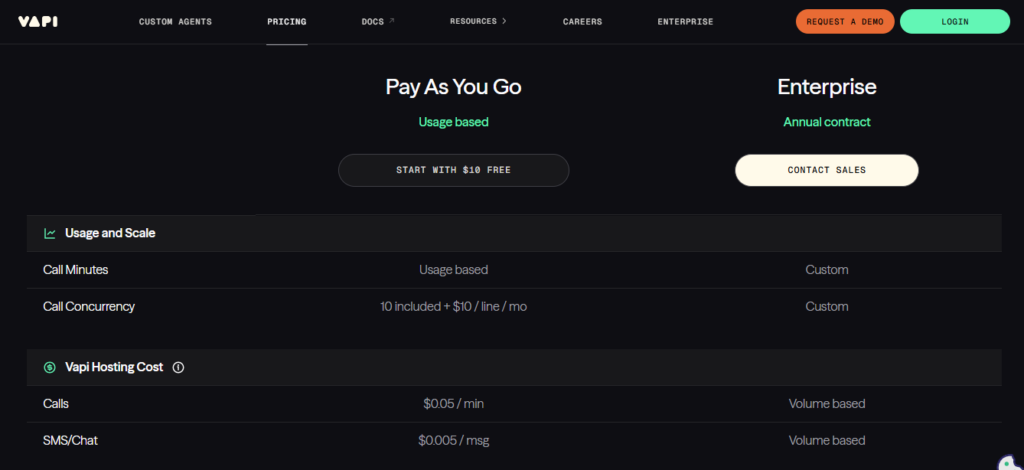
Vapi AI provides various plans for voice AI infrastructure, ranging from pay-as-you-go to enterprise solutions:
Ad-Hoc Infra (Pay as you go): This plan includes Call Hosting Cost at $0.05 per minute with $10 included, Call Model Cost (BYOK / At-cost), SMS/Chat Hosting Cost at $0.005 per message, and SMS/Chat Model Cost (BYOK / At-cost).
It also includes 10 concurrent lines and offers HIPAA / DPA / PCI for an additional $1000 per month. If you're looking for flexible, usage-based pricing, this plan offers a cost-effective entry point!
Agency ($500 / month): This plan includes 3000 Call Bundled Minutes, with Call Bundled Minutes Overage at $0.18 per minute. It covers Call Hosting Cost, Call Model Cost (BYOK / At-cost), SMS/Chat Hosting Cost at $0.005 per message, and SMS/Chat Model Cost (BYOK / At-cost).
It also features 50 included concurrent lines (with an option for +$10/line/mo), GHL / Make, and HIPAA / DPA / PCI for an additional $1000 per month. This plan is designed for agencies needing a bundled minute solution. If this plan suits your needs, we'd appreciate it if you signed up!
Startup ($1000 / month): This plan includes 7500 Call Bundled Minutes, with Call Bundled Minutes Overage at $0.16 per minute. It covers Call Hosting Cost, Call Model Cost (BYOK / At-cost), SMS/Chat Hosting Cost at $0.005 per message, and SMS/Chat Model Cost (BYOK / At-cost).
It also features 100 included concurrent lines (with an option for +$10/line/mo), GHL / Make, and HIPAA / DPA / PCI for an additional $1000 per month. This plan is suitable for startups requiring a higher volume of bundled minutes. If you choose this plan, consider supporting us when you make your purchase!
Enterprise (Custom): This plan offers unlimited Call Bundled Minutes and covers Call Hosting Cost, Call Model Cost (BYOK / At-cost), SMS/Chat Hosting Cost at $0.005 per message, and SMS/Chat Model Cost (BYOK / At-cost).
It includes unlimited concurrent lines, GHL / Make, and HIPAA / DPA / PCI for an additional $1000 per month. Additionally, it offers Add-on SIP, SOC-2 Procurement, SSO, SLA, Enterprise Cluster, Enterprise Integrations, and dedicated Support. Contact sales for a tailored solution for your specific enterprise needs!
If you're considering this enterprise solution, reaching out would be a great way to support our work!
Disclaimer: Pricing details may change. Visit the official Vapi AI website for the latest information.
What Makes Vapi AI Unique?
Vapi AI distinguishes itself in a crowded market of conversational AI tools through several key differentiators, primarily catering to a developer-first philosophy.
Developer-First, API-Driven Approach with Unparalleled Control: While some platforms offer a “low-code” or “no-code” builder, Vapi AI is fundamentally designed for developers. Its API-first architecture means that everything can be programmatically controlled, offering the deepest level of customization. This contrasts sharply with more restrictive, turnkey solutions, giving engineers the freedom to build exactly what they need.
True “Bring Your Own Model” (BYOM) Ecosystem: Vapi AI doesn't lock users into its own set of pre-selected AI models. The ability to integrate with over 35+ models from 16+ providers (for STT, LLM, and TTS) by using your own API keys is a significant advantage. This allows businesses to constantly adapt to the latest advancements in AI, optimize for very specific performance/cost requirements, and maintain flexibility. For example, a team might use the latest bleeding-edge LLM for complex reasoning, a highly accurate STT for specific accents, and a custom-cloned voice from ElevenLabs, all within the Vapi framework.
Focus on Real-time, Low-Latency Conversational Flow: Vapi AI's core engineering is optimized for ultra-low latency (<500ms voice-to-voice). This is paramount for natural phone conversations where delays can quickly make an AI sound robotic or frustrating. Vapi's real-time orchestration of STT, LLM, and TTS is a complex technical feat that provides a genuinely fluid user experience.
Powerful Tool Calling and Agent Chaining (Squads): Beyond basic Q&A, Vapi AI empowers developers to build truly intelligent agents that can interact with external systems and even collaborate with other AI agents. The robust tool calling for backend actions and the concept of “Squads” (agent chaining) for multi-domain complexity set it apart from simpler voice bot builders.
Comprehensive SDKs and Developer Resources: Vapi provides extensive SDKs across multiple languages/frameworks (TypeScript, Python, Node.js, React, Flutter, iOS) and detailed API documentation. This robust developer ecosystem ensures that integrating Vapi into existing applications is as smooth as possible for technical teams.
Granular Cost Visibility: While its pricing structure can be complex due to its component-based billing, it offers granular visibility into the costs of each AI component (STT, LLM, TTS, platform usage, telephony). This allows highly technical teams to actively monitor and optimize their AI spending by selecting the most cost-effective models for different aspects of their conversational flow.
These unique aspects position Vapi AI as a powerful foundational layer for developers seeking to build highly customized, performant, and scalable real-time voice AI applications.
Vapi AI Compatibilities & Integrations
Vapi AI's compatibility and integration capabilities are primarily driven by its API-first design and extensive SDK offerings, allowing it to fit into virtually any modern software ecosystem.
Web-Based Platform: The Vapi AI dashboard and Flow Studio are accessible via any standard web browser, providing a universal interface for agent management and monitoring.
Input Types:
- Audio Input (Real-time): Directly processes live audio streams from phone calls.
- Text Prompts & JSON Configuration: Agent behavior, system prompts, and conversational flows are defined using text and structured JSON data.
- API Calls/Webhooks: Can receive data and triggers from external applications via its API or webhooks to initiate calls or inform conversations.
- Knowledge Bases (Indirect): While Vapi doesn't have a native knowledge base feature, it can connect to external knowledge bases via tool calls or webhooks (e.g., retrieving information from a database, CRM, or document store).
Output Types:
- Synthesized Speech (Real-time): Generates human-like voice responses during calls.
- Call Transcripts: Provides full transcripts of conversations for analysis and record-keeping.
- Call Summaries: Can generate AI-powered summaries of calls.
- Extracted Data: Can extract specific entities or information from conversations (e.g., names, dates, intent).
- Webhook Events: Sends real-time data and events to external systems via webhooks (e.g., call status, detected intent, tool call results).
- API Responses: Can return data or status updates via its REST API.
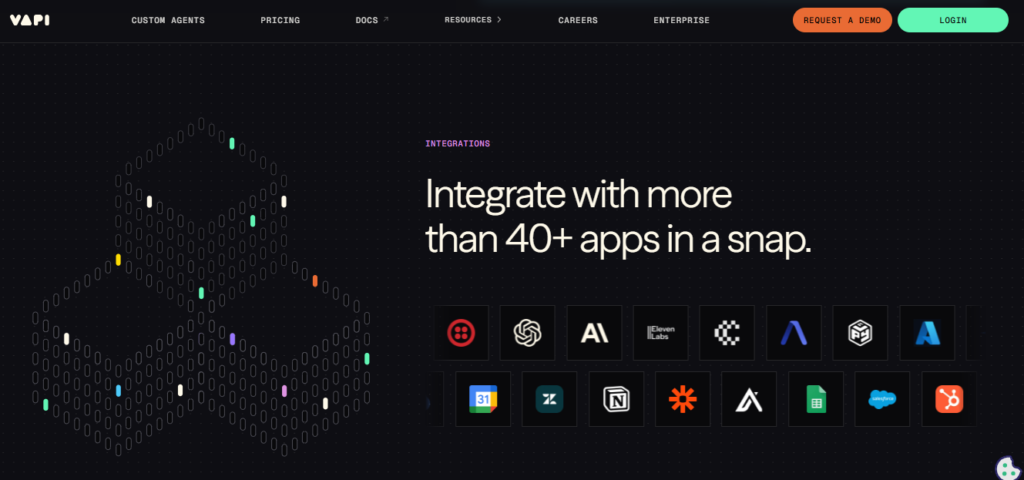
Core Integrations (Via BYO Keys & APIs):
- Large Language Models (LLMs): Integrates with a wide array of LLM providers via API keys:
- OpenAI (GPT-3.5, GPT-4o, etc.)
- Anthropic (Claude 3.x)
- Google (Gemini)
- Llama (various versions)
- And potentially others as new models emerge.
- Text-to-Speech (TTS) Providers: Supports multiple TTS providers for voice synthesis:
- ElevenLabs
- PlayHT
- Deepgram (for some TTS offerings)
- And other specialized voice providers.
- Speech-to-Text (STT) Providers: Integrates with leading STT engines for accurate transcription:
- Deepgram
- OpenAI Whisper
- And others.
- Telephony Providers: Directly integrates with major VoIP and telecom platforms:
- Twilio
- Vonage
- (Allows users to provision new numbers or bring existing ones).
Workflow Automation Platforms (Indirect, API/Webhook Driven):
- Make.com (formerly Integromat): Vapi AI can be extensively integrated with Make.com via webhooks and its API. This allows users to create complex multi-app workflows, such as:
- Triggering Vapi calls based on events in CRMs (e.g., new lead in Zoho CRM, Close CRM).
- Sending call transcripts and data to Google Sheets, Airtable, or project management tools (e.g., ClickUp, Teamwork CRM).
- Updating CRM records (e.g., Close CRM, Zoho CRM, Teamwork CRM) based on call outcomes.
- Sending follow-up emails via email marketing platforms.
- Zapier: Similar to Make.com, Zapier can be used to connect Vapi AI with thousands of other business applications through its API and webhook capabilities.
- Pabbly Connect: Supports Vapi AI integrations, allowing users to connect Vapi with over 2,000+ apps for various CRM, sales, marketing, and productivity automations.
Developer Ecosystem (SDKs & API):
- Client SDKs: Available for web (JavaScript), Flutter, React Native, iOS (Swift).
- Server SDKs: Available for TypeScript (Node.js), Python, with examples for Vercel, Cloudflare Workers, Supabase, Bun, Deno, Flask, Laravel, Go, Rust.
- REST API: Comprehensive API documentation (often via Postman) for full programmatic control.
Observability & Monitoring:
- Langfuse: Natively integrates with Langfuse, an open-source LLM engineering platform, for enhanced telemetry monitoring, trace visualization, and debugging of AI agent interactions.
Security & Compliance:
- HIPAA & SOC 2 Certified: Ensures robust data security and privacy, critical for industries handling sensitive information like healthcare.
Vapi AI's highly programmable nature means that while some integrations require custom development, the possibilities for connecting it to any part of a business's digital infrastructure are virtually limitless, making it a flexible foundation for advanced conversational AI.
How We Rated It Vapi AI
3 Top Vapi AI Alternatives
Looking for Vapi AI alternatives? Please Check out below Top 3 Vapi AI alternatives options to consider:
Each alternative offers unique features that might better suit your specific needs. Consider your primary use case, budget, and required features when choosing between these options.
Summary Vapi AI Review
Vapi AI is a formidable and highly capable platform meticulously crafted for developers and engineering teams seeking to build, test, and deploy real-time AI voice assistants for phone calls with unparalleled control and flexibility. Its primary function, as evidenced by its official website and extensive industry analysis, is to serve as the foundational infrastructure for highly customizable conversational AI solutions.
The platform excels in its real-time voice orchestration, seamlessly integrating best-of-breed Speech-to-Text, Large Language Models, and Text-to-Speech providers, often achieving sub-500ms voice-to-voice latency for truly natural interactions.
The “Bring Your Own Model” (BYO) approach is a significant differentiator, empowering developers to choose from over 35+ models from various providers, optimizing for cost, performance, and specific use case requirements. Its robust tool calling and webhook routing capabilities allow AI agents to interact dynamically with external systems, making them not just conversational but deeply integrated and actionable.
Furthermore, the innovative agent chaining (“Squads”) feature enables the creation of highly complex, multi-domain AI systems, catering to enterprise-level demands.
While Vapi AI offers a visual Flow Studio, its inherent developer-first nature means it presents a steeper learning curve for non-technical users and its component-based pricing can be more intricate to manage than bundled solutions.
It also lacks native batch outbound campaign management and comprehensive out-of-the-box CRM integrations, relying on its robust API and webhook capabilities for such connections.
Compared to alternatives like Synthflow AI (no-code, turnkey), Voicegenie AI (best for AI Phone call automation), and Voiceflow AI (Multichannel Voice UX Design), Vapi AI carves out its niche as the go-to platform for technical teams that demand maximum customization, granular control over the AI stack, superior performance, and the flexibility to integrate deeply with existing backend systems.
For organizations with dedicated engineering resources looking to build cutting-edge, bespoke voice AI applications, Vapi AI provides the powerful and flexible canvas needed to innovate and scale.
Vapi AI FQA:
What is Vapi AI's primary function?
Is Vapi AI a no-code platform?
Can I use my own AI models with Vapi AI?
How quickly do Vapi AI agents respond?
Can Vapi AI agents perform actions beyond just talking?
Does Vapi AI support multiple languages?
How does Vapi AI handle complex conversations?
What kind of integrations does Vapi AI offer?
Is Vapi AI suitable for high-volume call centers?
How is Vapi AI priced?
Did you find this content helpful?
Authority Hub
Check complete Vapi AI features
Alternatives
Best Vapi AI alternatives in 2026
Comparison
Compare Vapi AI vs competitors
Best Tools
Best AI tools in AI Agents
Top Tools
Top AI Agents AI tools ranked
Tutorial
Watch Vapi AI Step-by-Step Tutorial
AI Tools Directory
Discover 331 AI tools list
Submit Tool
Add your AI tool here for free
AI Tool Coupons
Unlock exclusive deals & discounts
Did you find this content helpful?
Promote This Tool
Help others discover this tool by sharing this page.
Vapi AI Reviews
Write a Review
No reviews yet. Be the first to share your thoughts!
48 Similar Vapi AI Tools
Track rankings, monitor AI search visibility across 8 models, audit 200+ technical SEO checks, and manage backlinks — all from one affordable platform.
The world's first conversational SEO agent — OTTO runs technical fixes, content, link building, and AI visibility across 60+ tools in one platform. $99/month replaces $8,000/month in tools.
Track your brand's visibility across 17+ AI engines — ChatGPT, Perplexity, Claude, Gemini, DeepSeek, Grok, Copilot, Mistral, and more — with the most comprehensive GEO platform built for 2026.
Own traditional and AI search with one platform — 5.4B keywords, 2.2B domain profiles, and AI visibility tracking across 8 engines.
1-click AI humanization with the market's most affordable bundled plan — AI humanizer, SEO+AEO article agent, plagiarism checker, grammar checker, and API access from $7/month annually.
A real-time B2B search engine that finds verified emails and cell phones instantly — 1 credit unlocks both — powered by AI and trusted by 500,000+ salespeople.
Scrape Sales Navigator, LinkedIn, and Apollo leads for free — pay only when you enrich with verified emails and phone numbers.
An AI sales copilot that analyzes your prospects, writes hyper-personalized outreach, and automates your entire multichannel pipeline — from first touch to booked meeting.
Turn your website into a 24/7 AI sales agent that qualifies visitors, captures leads, and books meetings — built for HubSpot-first teams.
Build, deploy, and monitor enterprise-grade AI agents and agentic workflows — all in your own infrastructure.
Build reliable, no-code AI Agents grounded in your company's data — for customer support, sales, and beyond.
Train an AI on your content and let it handle customer support 24/7—no code required.
Build and deploy autonomous AI agent workforces for sales, marketing, and operations — no code required.
Build and deploy intelligent AI agents trained on your data — no code, no friction.
Turn text, scripts, and blog posts into viral-ready videos in minutes — no editing skills needed.
Create, schedule, and automate your social media content across every major platform — with Travis AI writing captions in 26 languages, built-in workflows, and e-commerce integrations.
The all-in-one multichannel sales engagement platform that combines Email, LinkedIn, Video, and Dialer with AI to help your team close more deals — without software exhaustion.
AI-powered LinkedIn content platform that learns your writing voice and turns expertise into consistent influence — for individuals and teams.
Translate, dub, and lip-sync your videos into 110+ languages with studio-quality AI.
The all-in-one podcast hosting platform trusted by 600,000+ podcasters — unlimited storage, built-in AI tools, live streaming, and monetization starting at $12/month.
Generate ultra-realistic AI voiceovers, clone your voice, host podcasts, and create text-to-video content — 1,000+ voices in 142+ languages, starting at $19/month with a free trial.
Upload any audio or video file and get 75+ share-ready content assets — transcripts, audiograms, reels, articles, and more — in minutes, no prompts needed.
All-in-one AI voiceover, transcription, voice cloning, YouTube dubbing, and talking avatar platform — 1,000+ voices in 75+ languages from $12/month with a free trial.
Upload one audio or video file and get 100 ready-to-use content assets — transcripts, show notes, blogs, newsletters, and social posts — in minutes.
Generate studio-quality AI voiceovers in 140+ languages with 800+ voices, multi-voice scripts, voice style control, and commercial license — starting at $15/month with 2,000 free characters.
One platform for AI video generation, royalty-free music, text-to-speech, voice cloning, AI song covers, and video translation — powered by Sora2, Veo3, and 3,200+ voices in 190+ languages.
The all-in-one podcast hosting platform built for growth — unlimited shows, world-class analytics, AI tools, and monetization baked into every plan.
The fastest, most accurate AI voice generator for voiceovers, dubbing, and voice agents — 200+ ethically-built voices in 35+ languages, SOC 2 & HIPAA compliant, starting at $19/month.
Your AI marketing co-pilot — generate on-brand social posts, AI images, blogs, and competitor insights, then schedule across 7 platforms from one dashboard. Free plan available, paid from $49/month.
Turn talking-head videos into polished, B-roll-enhanced social clips in minutes — with 13.8M+ Getty iStock assets, AI subtitles, and auto music. Free plan available.
Turn any long video into viral shorts in minutes — AI captions, B-roll, faceless video, auto-translation in 48 languages, and social scheduling from $15/month.
Upload any PDF, ask it a question, and get a cited answer in seconds — no manual scrolling required.
Five beautifully designed SEO tools. One affordable plan. Trusted by 2.8M+ SEO pros since 2014.
Professional SEO managed by real humans, powered by AI — with the software fully included. No contracts. Starting at $99/mo.
Build your LinkedIn personal brand on autopilot with a personalised AI agent that creates, schedules, and optimises posts for you.
The AI-native cold email infrastructure platform trusted by 100,000+ businesses — unlimited mailboxes, 5–7 million mailboxes in the warm-up pool, 110M+ daily warm-up emails, and a SmartDialer built for high-volume agencies and enterprise GTM teams.
The safest LinkedIn and email outreach platform using mobile app APIs — AI-personalized voice notes, video messages, and an Appointment Setter Agent that books meetings while you sleep.
The AI sales engagement platform that unites email, parallel dialing, LinkedIn, SMS, and WhatsApp in one platform — helping 5,000+ sales teams execute 350 calls per hour and build predictable pipeline.
PhD-grade AI Super Agent that researches, drafts, cites, grades, and humanizes academic content — all from a single chat interface.
The simplest podcast hosting platform on the web — get your show on Apple Podcasts, Spotify, YouTube, and Amazon Music in minutes, trusted by 120,000+ active podcasters since 2009.
Create AI-hosted podcasts with voice clones, editable scripts, and one-click distribution to Spotify, Apple Podcasts, and YouTube — no studio, no recording required.
Record, edit, transcribe, clone your voice, and publish studio-quality podcasts and videos — all in one AI-powered platform, now rebranded as Async.
Upload any audio or video and get unlimited clips, audiograms, show notes, articles, newsletters, social posts, and a built-in episode chatbot — starting at $0/month.
Upload one podcast episode and get transcripts, show notes, blog posts, social clips, audiograms, and AI audio enhancement — all automated in minutes, trusted by 70,000+ creators.
Generate images, write content, build chatbots, and automate workflows — all from one MCP-native AI platform.
Design, build, and launch AI Agents collaboratively.
Automate sales & support with human-like voice bots.