Home Categories Deals Sign Up
Updated: April 25, 2026

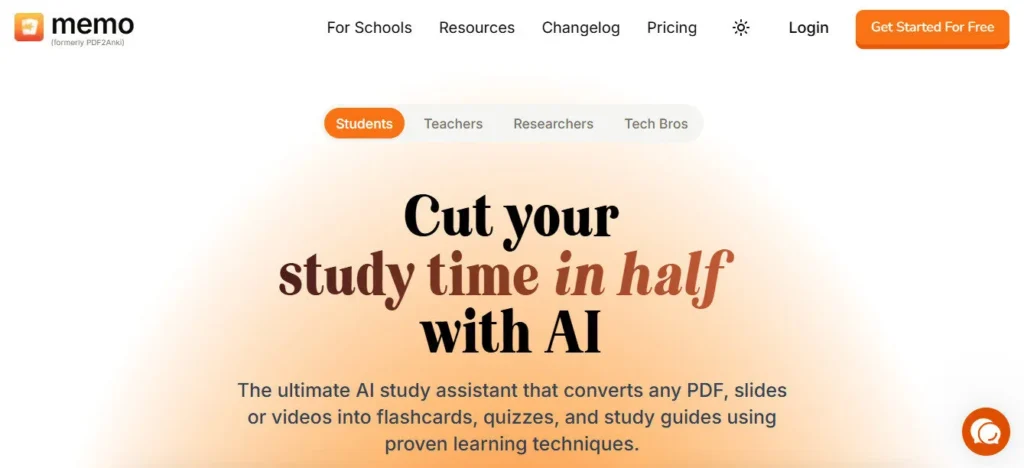
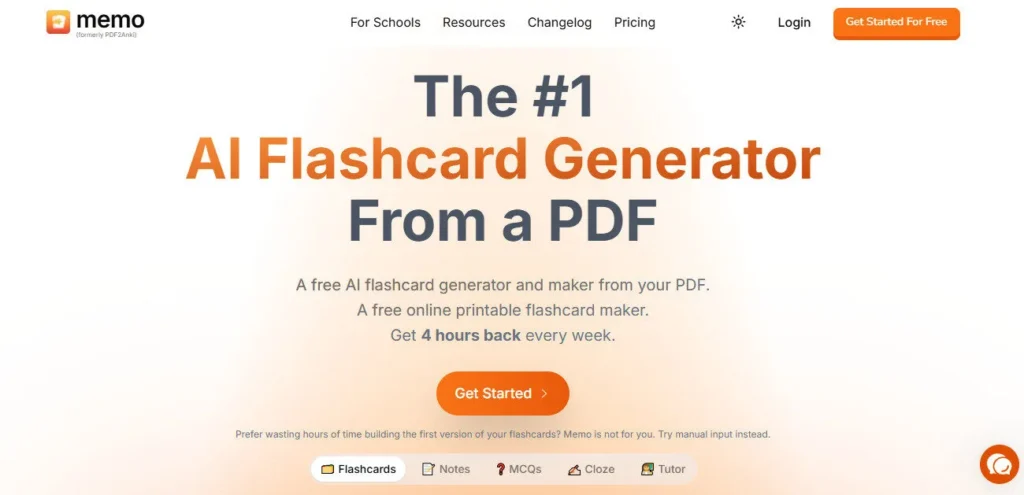
Memo AI in Action: From Any Source to Your Entire Study System

Memo AI AI tool – Memo was built in the common room of a Hong Kong medical school in 2023, when co-founder Jason Chan and a fellow med student got tired of manually converting hundreds of pages of dense clinical material into flashcards for Anki.

They started with a simple tool called PDF2Anki, rebranded to Memo in October 2024, and in February 2026 shipped V8 — a full AI knowledge workspace for students, academics, and professionals generating $29K MRR bootstrapped and trusted by 300,000+ learners worldwide.

That founding context matters: every feature in Memo was designed by people who studied from the exact same material types it processes, using the same active recall and spaced repetition principles they were being tested on in medical school.

Key Capabilities

Every Memo notebook follows a three-step workflow: Sources → Chat → Studio. In Sources, you upload PDFs with exact page range selection, YouTube lectures with transcript-based context, websites, and pasted text — all fed through a 6-phase RAG pipeline that parses, semantically chunks, vector-embeds, retrieves, generates, and quality-assures outputs before you see them, with built-in hallucination detection and citation verification at Phase 6.

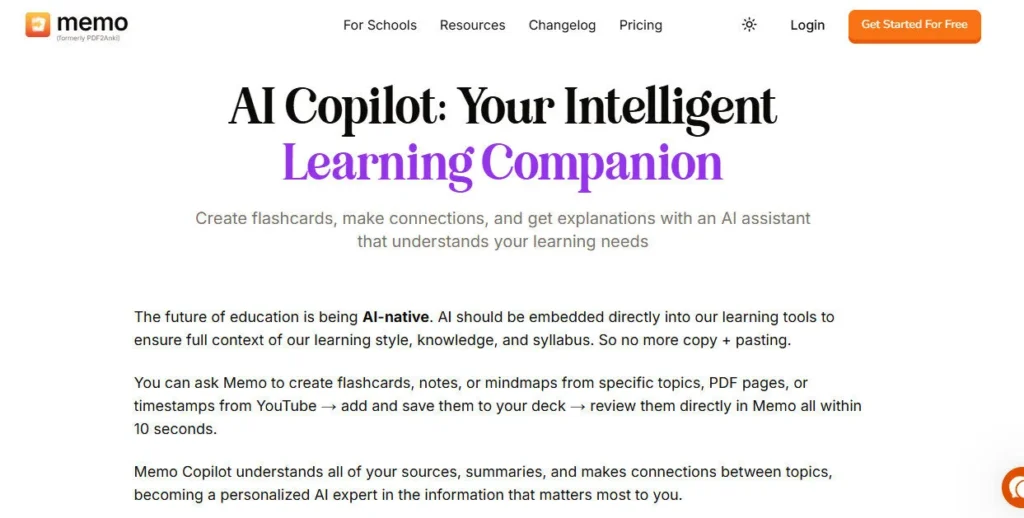
In Chat, an AI Copilot drawing from Claude, GPT, Gemini, DeepSeek, or Memo 1 answers questions with citations to exact pages or video timestamps so you can verify every response without leaving the notebook.

In Studio, a single source set generates eight distinct output types: flashcards (basic, quiz, cloze in Standard or Deep Dive mode), notes (bullet, table, Cornell, summary, toggles, or custom), mind maps, learning tracks, practice tests (SAQ, MCQ, or mixed), infographics, podcasts with duration controls, and AI tutor sessions.

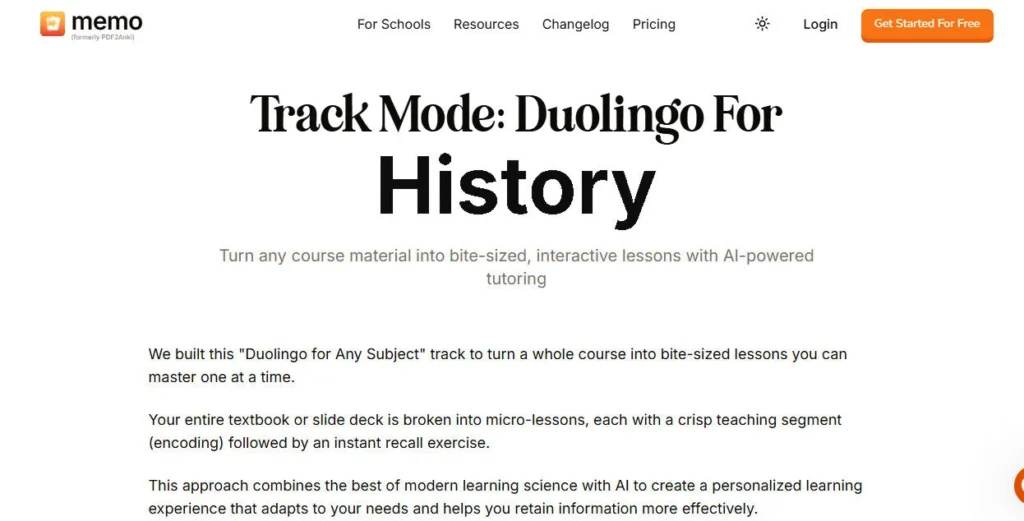
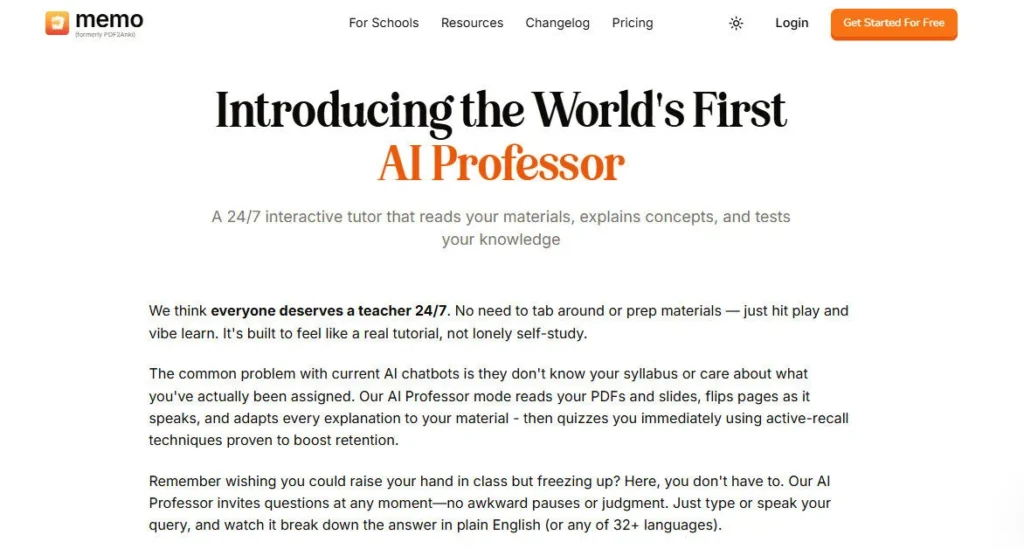
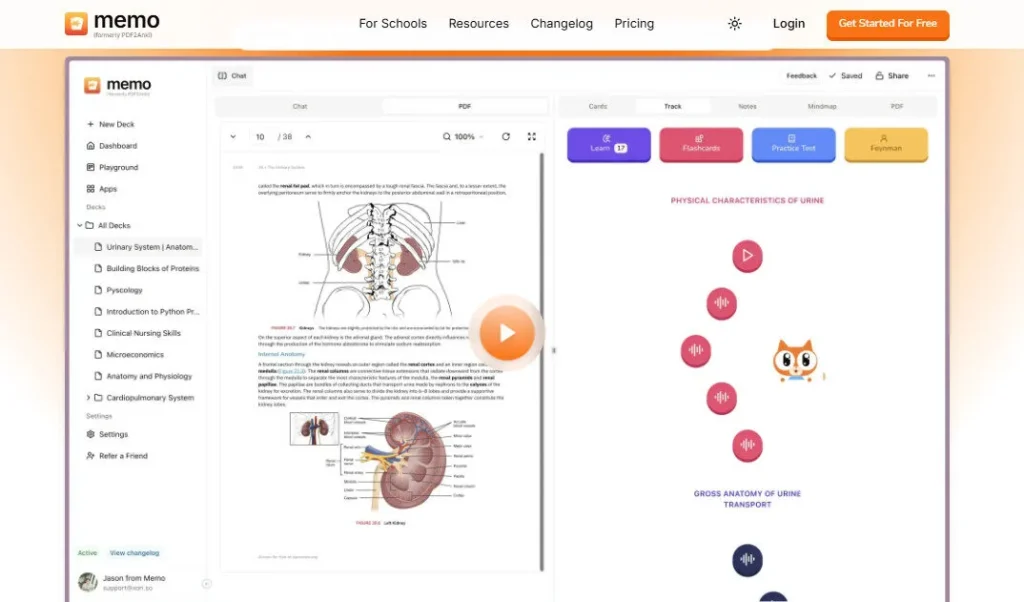
Flashcard review uses six layouts — Column, Toggle, List, Typing, Learn Mode, and Manual Grade — with smart spaced repetition scheduling built in. Track Mode transforms dense documents into AI Professor-narrated walkthroughs: voice explanations, auto page-flipping, comprehension checks, and visual narration of diagrams and charts in 32 spoken languages. Everything exports to Anki, text, PDF, and Markdown.

Who Gets the Most Out of It

Medical and STEM students studying for high-volume licensing exams (USMLE, NCLEX, bar exams) get the most immediate ROI: the combination of cloze flashcards, Deep Dive generation mode, and direct Anki export covers the entire pre-exam preparation workflow without switching apps.

Learners who study from video lectures — common in university coursework and online certification programs — use YouTube source ingestion and Track Mode to extract AI-structured flashcard decks and guided walkthroughs from hours of video content at a fraction of the watch time.

Researchers and professionals processing large technical document sets use the multi-source notebook, cross-document reasoning Copilot, and infographic generation to extract structured knowledge from reports they do not have time to read fully.

Is It Worth It?

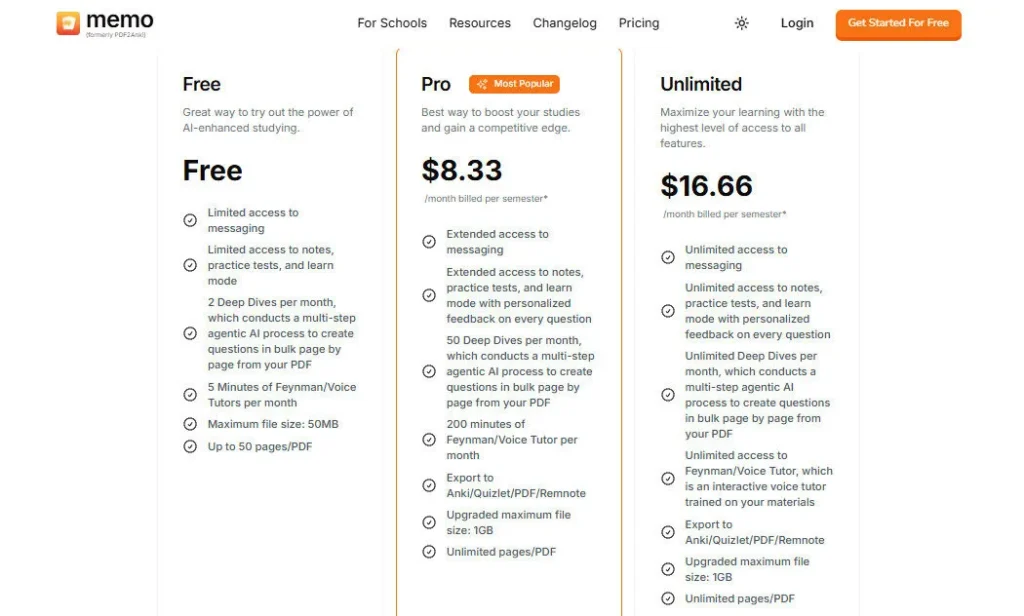
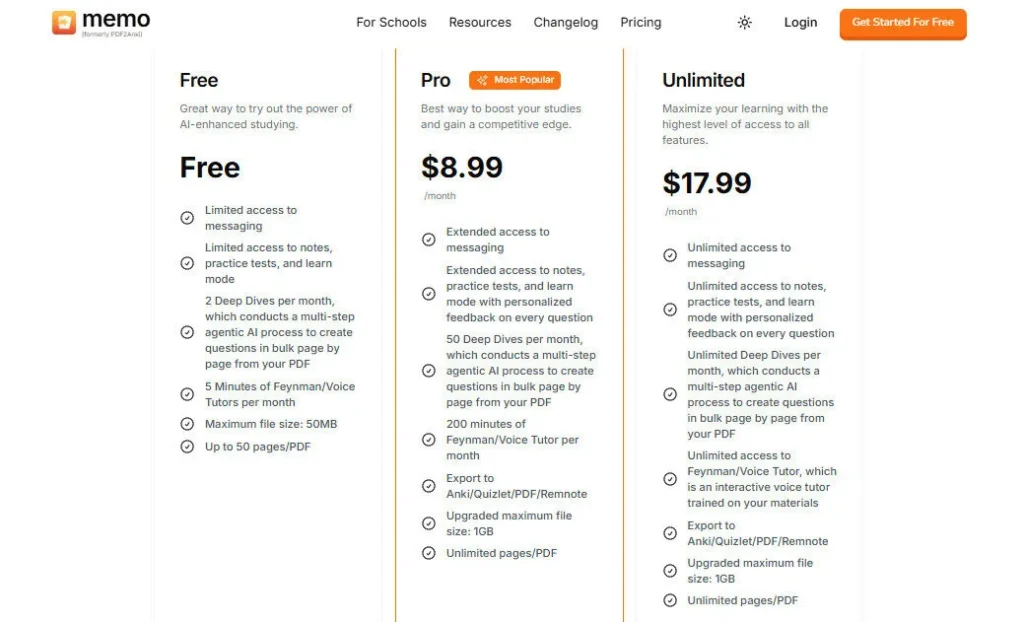
The free plan is genuinely functional — 30 energy per month, every Studio output type available, up to 50 MB per file, 30+ languages, and no credit card required. For regular students, Pro at $7.17/month annually delivers 3,000 energy, 1 GB file uploads, access to GPT-5.2, GPT-4.1, Gemini 3.0 Flash, and DeepSeek V3.2, and full export capabilities.

Max at $14.17/month adds Claude Sonnet 4.6 in Copilot and 9,000 energy for daily intensive workflows. Both paid plans are among the lowest price points in the AI study tools category for the breadth of output types included.

The honest limitation is that the energy credit system creates consumption awareness — heavy multi-source generation runs can exhaust monthly energy faster than the plan tier suggests for users running Studio across large document sets daily.

Memo AI is an AI-powered knowledge workspace founded in July 2023 by Jason Chan and a co-founder — both medical students in Hong Kong — originally as PDF2Anki and rebranded to Memo in October 2024. With 300,000+ users and $29K monthly recurring revenue bootstrapped, it processes PDFs, YouTube videos, websites, and text through a 6-phase RAG pipeline and generates eight distinct output types from a single source set: flashcards with spaced repetition, notes in six styles, mind maps, practice tests, learning tracks, infographics, AI-narrated podcasts, and voice-based tutor sessions — all with citation-verified answers and export to Anki, PDF, text, and Markdown in 99+ languages.

• Content Studio with 8 Output Types — Generates flashcards, notes (bullet/table/Cornell/summary/toggles/custom), mind maps, practice tests (MCQ/SAQ/mixed), learning tracks, infographics, AI podcasts, and tutor sessions from a single uploaded source set — every format customizable by difficulty, style, question count, and language.

• 6-Phase RAG Pipeline with Hallucination Detection — Processes all sources through a six-stage pipeline: document ingestion with OCR, semantic chunking with context-aware boundary detection, OpenAI 1536-dimensional vector embedding, hybrid semantic + keyword retrieval with cross-document reasoning, multi-model AI generation, and quality assurance with hallucination detection and citation verification.

• Track Mode with AI Professor Voice Tutoring — Transforms dense documents into narrated walkthroughs: the AI explains concepts aloud, pages auto-flip in sync, diagrams and charts are verbally narrated, comprehension checks interrupt at key points, and voice conversations allow real-time Q&A in 32 spoken languages.

• Multi-Source Copilot with Exact Citations — Chat against all uploaded sources simultaneously using Claude, GPT, Gemini, DeepSeek, or Memo 1, with every answer citing the exact page number or video timestamp so every response is immediately verifiable without reopening the source.

• Flashcards with 6 Review Layouts + Smart Spaced Repetition — Supports basic, quiz, and cloze card types reviewed via Column, Toggle, List, Typing, Learn Mode, and Manual Grade layouts; intelligent spaced repetition schedules each card based on performance data; audio-based review and flashcard-level chat for misconception diagnosis built in.

• Anki Export with Cited Cards — Every generated flashcard includes a citation to the exact page or timestamp in the source document; export entire decks to Anki-compatible format for students with established Anki workflows, preserving card content and source linkage.

• Podcast Generation from Study Materials — Converts any uploaded source set into an AI-generated podcast with configurable style and duration — a uniquely passive study format that no other AI flashcard or study tool in this category offers, making dense material accessible during commutes or hands-free sessions.

• 99+ Input Languages, 32+ Spoken Output Languages — Processes source content in over 99 languages and supports voice output in 32 languages for Track Mode narration, making Memo one of the most linguistically inclusive AI study tools available globally.

Pros
  • Founded by 2 medical students actively using the product for the same exam types as their users — every feature reflects genuine firsthand academic use-case knowledge
  • 300,000+ users and $29K MRR bootstrapped is one of the strongest independent growth signals in the AI study tools category
  • 6-phase RAG pipeline with Phase 6 hallucination detection and citation verification makes source-linked outputs measurably more trustworthy than tools without explicit quality assurance
  • Eight distinct Studio output types — including AI-generated podcasts and infographics — from a single source set with no extra charge
  • Direct Anki export with source citations serves medical students and serious flashcard users who already have established Anki workflows
  • Free plan includes all eight Studio output types with no credit card required — the most generous feature-access free tier in the AI flashcard category
  • Track Mode's voice-narrated AI Professor with auto page-flipping is a uniquely passive study format absent from every competing tool at this price point
Cons
  • ×Energy credit system means heavy Studio users running multi-source generation sessions can deplete monthly allowances faster than the nominal per-month figure implies
  • ×Free plan's 30 energy per month and 50 MB file limit allows only limited generation before upgrade pressure kicks in
  • ×Bootstrapped 2-person founding team means feature development pace and support response time are constrained by team capacity, even with active build-in-public transparency from co-founder Jason Chan
  • ×No built-in citation management or reference library for academic paper workflows — Memo is a study and retention tool, not a research and writing platform
  • ×Podcast and infographic generation, while unique, are one-directional passive outputs with limited post-generation editing compared to dedicated podcast or design tools
  • ×No LMS integration with Canvas, Blackboard, or Google Classroom for automatic course material import

Memo AI is built for learners at any level who need to convert dense source material into active recall study systems — particularly those studying from video lectures, scanned documents, or large multi-source content sets.

• Medical and professional licensing exam students — USMLE, NCLEX, bar exam, and CPA candidates use the cloze card generation, Deep Dive mode, spaced repetition scheduling, and direct Anki export to cover high-volume memorization requirements without manual card creation.

• University students learning from video lectures — YouTube lecture ingestion with transcript-based context and Track Mode narration let students extract structured flashcard decks and guided walkthroughs from hours of recorded lectures faster than re-watching.

• Professionals and researchers processing dense documents — Multi-source Copilot with cross-document reasoning, infographic generation, and podcast output allow professionals to extract structured knowledge from technical reports and research papers without linear full-document reads.

• Language learners and international students — 99+ input languages and 32 spoken output languages make Memo one of the most accessible AI study tools for non-English learners who study in multiple languages simultaneously.

• Students transitioning from Anki or Quizlet — Users with established Anki workflows use Memo to automate card creation from their lecture materials while exporting to Anki for review, combining Memo's generation speed with Anki's mature review algorithm.

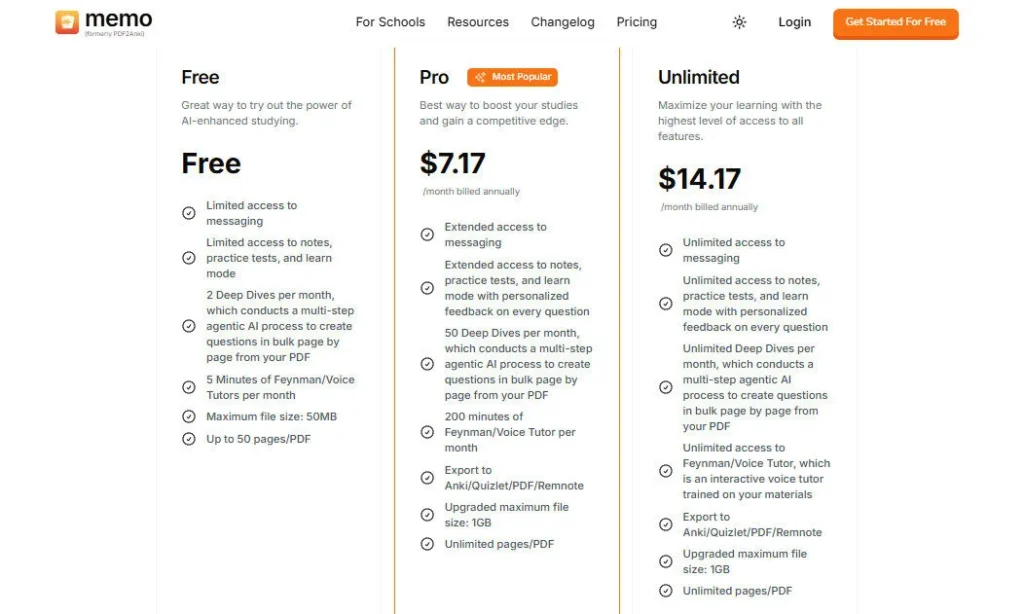
Free ($0/mo — no credit card required)30 energy per month (resets on the 1st), all 8 Studio output types (flashcards, notes, mind maps, practice tests, learning tracks, infographics, podcasts, tutor), Standard and Deep Dive generation modes, Learn Mode + Cram review, multi-source Copilot chat, up to 50 MB per file, 30+ output languages — designed for full workflow evaluation at limited volume.
Pro ($7.17/mo billed annually — most popular)3,000 energy per month, everything in Free at much higher generation volume, AI Copilot with GPT-5.2, GPT-4.1, Gemini 3.0 Flash, and DeepSeek V3.2, full customization of difficulty, style, question count, prompts, and language, export to Anki, text, PDF, and Markdown, up to 1 GB per file — built for weekly coursework and research workflows.
Max ($14.17/mo billed annually)9,000 energy per month, everything in Pro, Claude Sonnet 4.6 added to Copilot model selection on top of every Pro model, extra headroom for tutor, podcast, and practice test workflows, ideal for multi-source decks and repeated Studio runs — built for daily intensive workflows.
Teams (Custom — contact Memo)For schools, bootcamps, and organizations with shared curricula; shared source libraries, team notebooks, instructor tools for converting lecture packs and internal docs into reusable study assets; contact via memo.cards.

Memo's deepest technical differentiator is its 6-phase RAG pipeline with explicit Phase 6 quality assurance — an architecture rare in student-focused AI tools and typically found only in enterprise knowledge management platforms.

• Phase 6 RAG Quality Assurance with Hallucination Detection — Most AI study tools generate outputs and deliver them immediately. Memo's pipeline validates every generated response against source documents, detects hallucinations, verifies citations, and assigns confidence scores before output delivery — making its Copilot answers measurably more trustworthy than tools without an explicit quality gate.

AI Podcast Generation from Study Materials — No other AI flashcard or study guide tool in this category offers AI-generated podcast output from your own uploaded course material. Memo converts any source set into a listenable study podcast with configurable style and duration, enabling passive study during commutes, exercise, or hands-free sessions — extending the reach of study time beyond screen time.

• Track Mode with Auto Page-Flip and Visual Narration — The AI Professor voice tutor narrates document content, flips PDF pages in sync, verbally explains diagrams and charts, and pauses for comprehension checks — functioning as a self-guided narrated textbook. No competing AI flashcard or study guide tool offers synchronized voice navigation through an uploaded PDF at this level of integration.

• Built by Active Medical Students, Used by Their Peers — Memo's founding story is not marketing — Jason Chan is publicly documented as a fourth-year medical student actively building the product while in clinical training. The cloze card support, Anki export, Deep Dive generation mode, and OCR for scanned clinical documents were all built by someone sitting the same exams as Memo's primary user base.

Memo AI is a multi-platform workspace designed to ingest sources from everywhere students and professionals actually encounter them and export to the tools they already use for review.

• Anki Export — Exports complete flashcard decks to Anki-compatible format with source citations preserved, serving the large population of medical and professional exam students who rely on Anki's proven review algorithm and do not want to abandon established study workflows.

• PDF Upload with Page Range Selection — Users can specify exact page ranges before processing rather than ingesting entire documents, enabling targeted flashcard and note generation from specific chapters or sections without processing irrelevant material.

• YouTube Lecture Ingestion — YouTube video URLs are processed via transcript-based context extraction, allowing structured study outputs from any publicly available lecture, course video, or educational content without downloading or re-watching.

• Multi-Format Export — Finished outputs export to Anki (.apkg), text, PDF, and Markdown formats, covering every downstream tool a student or professional might use for review, sharing, or documentation.

• Multi-Model AI Backend — Copilot supports Claude (Anthropic), GPT-5.2 and GPT-4.1 (OpenAI), Gemini 3.0 Flash (Google), DeepSeek V3.2, and the proprietary Memo 1 model — giving users model selection flexibility without locking outputs to any single provider's availability or capability.

CategoryScoreWhy It Matters
Accuracy & Reliability4.5/5Memo's 6-phase RAG pipeline with explicit Phase 6 hallucination detection, citation verification, and confidence scoring is the most rigorous quality assurance architecture in the AI study tools category at this price point. Every Copilot answer cites the exact page number or video timestamp from the source document, enabling one-click verification. Flashcard content generated via Deep Dive mode produces more granular, concept-level cards than Standard mode for complex technical material. OCR support for scanned documents extends reliable processing to legacy academic materials common in medical education.
Ease of Use4.5/5The three-step Sources → Chat → Studio workflow is clearly communicated, consistently demonstrated in official demo videos by co-founder Jason Chan, and immediately navigable without onboarding. New users can upload a PDF and generate their first complete flashcard deck within minutes of signing up on the free plan. The energy system adds modest consumption awareness but does not complicate the core workflow. The V8 interface receives consistent praise in independent user testimonials on memo.cards/love for clean design despite expanding feature breadth.
Functionality & Features4.8/5No competing AI study tool at any price offers the same breadth of output types per source set: 8 distinct Studio formats including AI-generated podcasts and infographics, 6 flashcard review layouts, Track Mode with auto page-flip and voice narration, a 6-phase RAG Copilot, OCR, cloze cards, Anki export, cross-document reasoning, and 99+ language support in a single workspace. The V8 update formalized the evolution from flashcard generator to complete knowledge workspace. Podcast and infographic generation alone are uniquely differentiating capabilities absent from Anki, Quizlet, Mindgrasp, and every tool at this price.
Performance & Speed4.3/5Standard flashcard deck generation from a typical PDF chapter completes in seconds. Deep Dive mode and multi-source Studio runs take longer proportionally to source length and generation complexity — expected given the 6-phase pipeline processing involved. Track Mode voice narration with auto page-flip renders smoothly across standard document lengths. The platform is actively maintained with rapid iteration evidenced by the V8 release and frequent changelog updates, with no widespread performance issues reported across 300,000-user scale.
Customization & Flexibility4.6/5Every Studio output is customizable via the Edit icon: language, style (six note formats, three flashcard types), difficulty level, question count, and custom prompts per generation run. PDF source ingestion allows exact page range selection before processing — a precision level most competing tools do not offer. Six flashcard review layouts cover visual, kinesthetic, and recall-test preferences. Tutor persona selection (Feynman vs. Strict Professor) adds meaningful pedagogical customization. AI model selection across multiple frontier providers gives advanced users control over output quality and cost.
Data Privacy & Security4.0/5Memo is built and operated by a Hong Kong-based medical student founding team with GDPR-aware practices for its international 300,000-user base. The 6-phase RAG pipeline processes uploaded documents server-side; content is grounded in user sources and not fed into model training. Formal SOC 2 certification and detailed institutional data processing agreements are not prominently published, which is a transparency gap for university departments or healthcare institutions uploading patient or pre-publication research documents.
Support & Resources4.2/5Co-founder Jason Chan documents the Memo build-in-public journey on X and LinkedIn, publishing changelog updates, product context, and direct user engagement with unusual transparency for a tool of this scale. The official Memo YouTube channel publishes demo videos for every major release. An active Wall of Love testimonial page and 300,000-user community provide peer support and use-case documentation beyond official materials. As a two-person founding team in medical school, SLA-backed support and formal help center documentation are limited — the honest trade-off of a bootstrapped operation at this revenue level.
Cost-Efficiency4.8/5At $7.17/month annually for the Pro plan, Memo delivers 8 Studio output types, GPT-5.2, GPT-4.1, Gemini 3.0 Flash, DeepSeek V3.2, Anki export, Track Mode voice tutoring, podcast generation, and a 6-phase RAG Copilot with hallucination detection — a combination that previously required 3–4 separate subscriptions. The Max plan at $14.17/month adds Claude Sonnet 4.6 and 9,000 energy for daily heavy users. The free plan's zero-credit-card, full-feature-access structure is the most generous AI study tool free tier in the category. Bootstrapped at $29K MRR, the pricing is deliberately accessible to the student demographic the founders know firsthand.
Overall Score4.5/5Memo AI is the most technically sophisticated and feature-complete AI knowledge workspace available to students at under $15/month in 2026 — built by two active medical students who are their own target users, scaled to 300,000 learners on a bootstrapped budget, and shipped V8 as a full AI knowledge platform in February 2026. The 6-phase RAG pipeline, 8 Studio output types, Track Mode voice tutoring, podcast generation, and Anki export make it uniquely comprehensive. The energy credit consumption model and two-person team support capacity are the honest constraints. For students who want to genuinely retain what they study rather than passively process it, Memo is the most thoughtfully designed tool in its category.

Memo AI is the most technically sophisticated AI study tool available at its price point in 2026 — built by two bootstrapped medical students who shipped a 6-phase RAG pipeline with hallucination detection, eight distinct Studio output types including AI podcasts, a voice-narrated AI Professor with auto page-flip, and direct Anki export at $7.17/month annually.

The energy credit model creates consumption awareness for heavy users, and the two-person founding team is a real constraint on support depth. For students, researchers, and professionals who want to genuinely internalize dense source material rather than passively encounter it, Memo V8 is the most complete active recall study workspace in the market today.

Q1.What is Memo AI and who built it?
Ans:-Memo AI (memo.cards) is an AI-powered knowledge workspace founded in July 2023 by Jason Chan and a co-founder — both medical students in Hong Kong. Originally launched as PDF2Anki, it rebranded to Memo in October 2024 and shipped V8 in February 2026 as a full AI knowledge workspace. With 300,000+ users and $29K monthly recurring revenue built entirely bootstrapped by a two-person founding team, it is one of the most organically grown AI study tools available today.
Q2.Is Memo AI free to use?
Ans:-Yes. Memo AI has a permanently free plan that requires no credit card and includes 30 energy per month, access to all 8 Studio output types, multi-source Copilot chat, Learn Mode and Cram review, and up to 50 MB per file. For students needing higher generation volume, the Pro plan is $7.17/month billed annually with 3,000 energy and 1 GB per file, and the Max plan is $14.17/month with 9,000 energy and Claude Sonnet 4.6 access.
Q3.What is the energy credit system in Memo AI?
Ans:-Memo uses an energy system to measure AI generation consumption. Free users receive 30 energy per month; Pro users receive 3,000 energy; Max users receive 9,000 energy — all resetting on the 1st of each month. Different Studio operations cost different amounts of energy depending on complexity — a simple flashcard deck costs less energy than a Deep Dive mode practice test across multiple large sources. The system is transparent, with a live generation trace showing energy consumption as it runs.
Q4.What is the Memo Content Studio?
Ans:-The Content Studio is the generation layer in Memo where your uploaded sources are converted into learning outputs. From one source set, Studio generates eight formats: flashcards (basic, quiz, cloze), notes (bullet, table, Cornell, summary, toggles, custom), mind maps, practice tests (MCQ, SAQ, or mixed), learning tracks, infographics, AI-narrated podcasts with duration controls, and tutor sessions with Feynman or Strict Professor personas. Every output is customizable by difficulty, style, question count, language, and custom prompts.
Q5.What is Track Mode in Memo AI?
Ans:-Track Mode is Memo's AI Professor feature that transforms uploaded documents into guided narrated walkthroughs. The AI explains content aloud, pages in the PDF auto-flip in sync with the narration, diagrams and charts are verbally described, and comprehension check questions pause the session at key points to verify understanding. Track Mode supports voice conversation for real-time Q&A in 32 spoken languages, making it function as a self-guided audio-narrated textbook from your own uploaded materials.
Q6.Does Memo AI export to Anki?
Ans:-Yes. Memo exports complete flashcard decks to Anki-compatible format with source citations preserved on every card. This is one of the platform's most important features for medical students and serious learners with established Anki workflows — it allows you to use Memo's AI generation speed to automatically create card decks and Anki's proven spaced repetition algorithm to review them, combining the best of both tools without manually creating cards.
Q7.What AI models does Memo AI use?
Ans:-The free plan uses default AI models. The Pro plan adds GPT-5.2, GPT-4.1, Gemini 3.0 Flash, and DeepSeek V3.2 to the Copilot. The Max plan adds Claude Sonnet 4.6 on top of all Pro models. For standard chat, users can choose from Claude, DeepSeek, ChatGPT, Gemini, or the proprietary Memo 1 model. Model selection is per-session, so you can switch based on task type without changing plan.
Q8.Can Memo AI generate flashcards from YouTube videos?
Ans:-Yes. Memo supports YouTube video URLs as a direct source input type. The ingestion pipeline extracts the video transcript with timestamp-based context, parses it for key concepts, and makes it available for all Studio generation modes — including flashcards, notes, practice tests, and mind maps. Every generated card or note item from a YouTube source cites the exact timestamp in the video so you can jump to the source clip for any item directly.
Q9.How many languages does Memo AI support?
Ans:-Memo AI supports over 99 languages for source content input and Copilot understanding, and 32+ languages for voice speech output in Track Mode. You can upload a document in any of 99+ languages, ask questions in a different language, and receive voice narration in a third language — making it one of the most linguistically flexible AI study tools available, particularly valuable for international students and multilingual academic programs.
Q10.How does Memo AI compare to Quizlet?
Ans:-Quizlet requires manual card creation or browsing user-generated shared decks. Memo AI generates flashcards automatically from your own uploaded sources — PDFs, YouTube videos, websites, and text — with zero manual creation required. Memo also offers seven additional output formats beyond flashcards (notes, mind maps, practice tests, podcasts, infographics, learning tracks, tutor), six review layouts, a Copilot for source Q&A, and direct Anki export. Memo saves students an average of 7+ hours per week versus manual Quizlet creation, according to the platform's own benchmark.

Promote This Tool

Help others discover this tool by sharing this page.

✓ Link copied to clipboard!

Memo AI Reviews

0.0
Based on 0 reviews
5 star
0%
4 star
0%
3 star
0%
2 star
0%
1 star
0%

Write a Review

Your Rating:

No reviews yet. Be the first to share your thoughts!

37 Similar Memo AI Tools