Home Categories Deals Sign Up
Updated: April 25, 2026

Inside SciSpace: A Smarter Way Through Academic Research

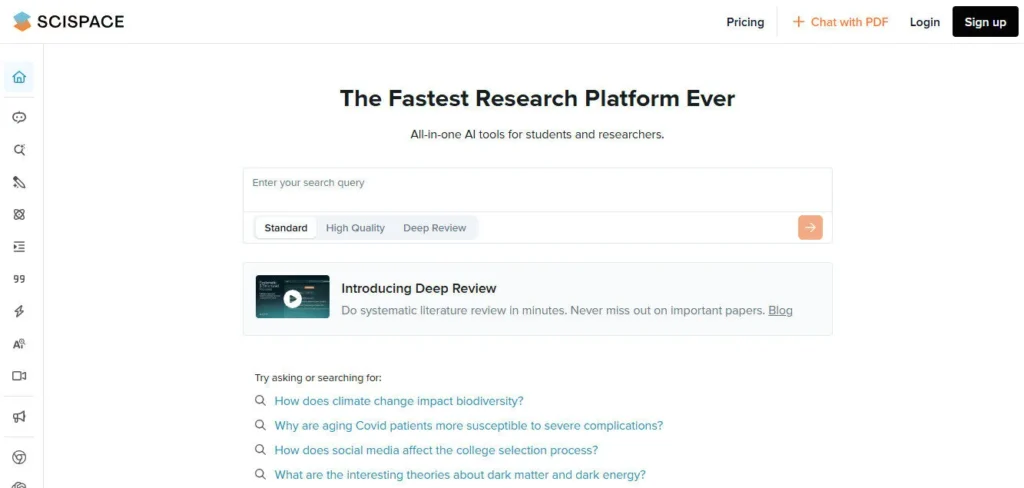
SciSpace is an AI research platform that gives you access to 285 million papers through a single natural-language interface. Instead of juggling a PDF reader, a reference manager, a paraphraser, and a writing tool separately, you get all of them unified in one workspace.

Over 1 million researchers from institutions including MIT, Stanford, Yale, and top pharmaceutical companies rely on it, making SciSpace the most widely adopted AI research platform for serious academic work in 2026.

Key Capabilities

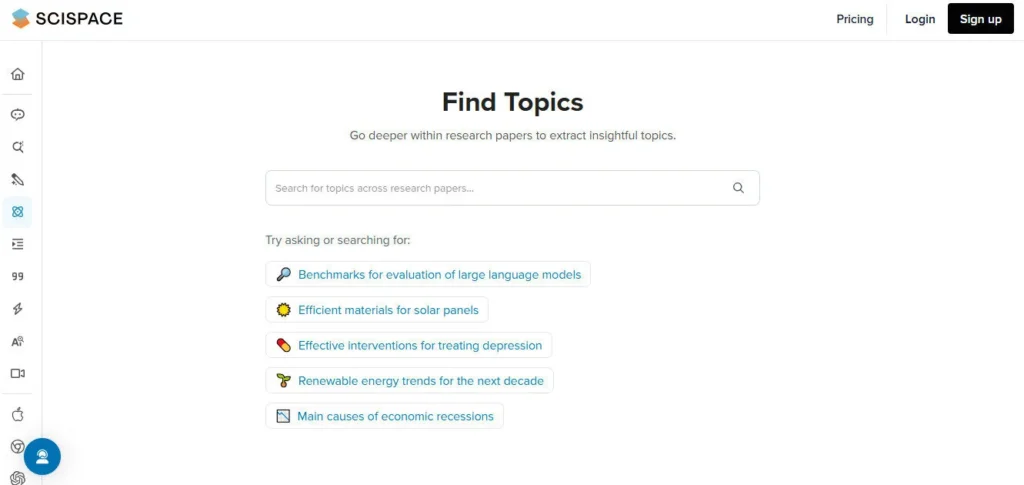
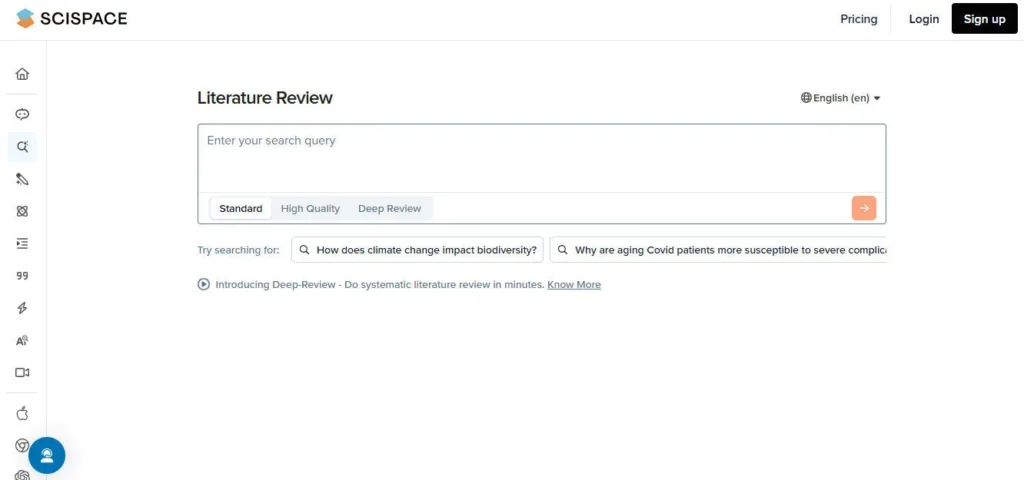
The core workflow starts with semantic search: type a research question — not keywords — and SciSpace queries its 285-million-paper database to return a synthesized answer with citations. From your results, you add papers to your library and run AI extraction columns that compare methodologies, conclusions, and limitations across all papers simultaneously in one unified table.

Chat with PDF lets you interrogate any individual document — including tables, equations, and figures — in natural language, with page-level citations on every response.

Deep Review, available on the Advanced plan at $90/month, launches an AI agent that processes up to 1,750 papers, identifies the most relevant, and generates a structured review complete with cited synthesis.

The 2026 Library Search and Report Writing Sub-Agent update extends this further: import your personal PDFs or your Zotero and Mendeley libraries, and the agent writes a full manuscript-style research report following proper academic structure, from introduction through references.

Who Gets the Most Out of It

PhD students doing literature reviews reduce weeks of manual work to hours by combining semantic search with AI extraction columns and Deep Review. Graduate students use PDF Chat to quickly understand dense methodology sections and unfamiliar terminology in fields outside their specialty.

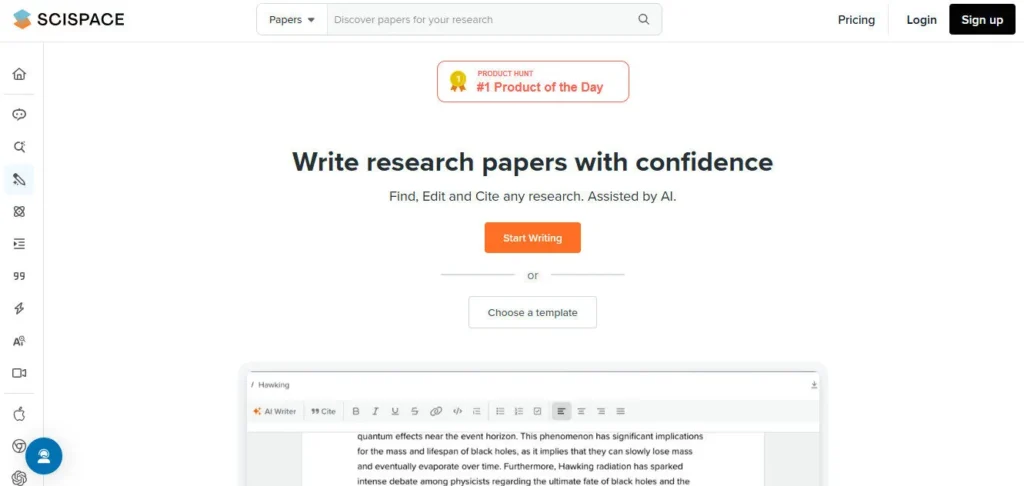
R&D teams in pharma and biotech run multi-PDF extraction for competitive intelligence and patent analysis. Researchers writing for publication use the AI Writer with real-time citation suggestions drawn directly from the SciSpace database, with an automatic reference list that updates as you draft.

Science journalists and educators use text simplification to convert dense academic language into clear, accessible summaries for general audiences.

Is It Worth It?

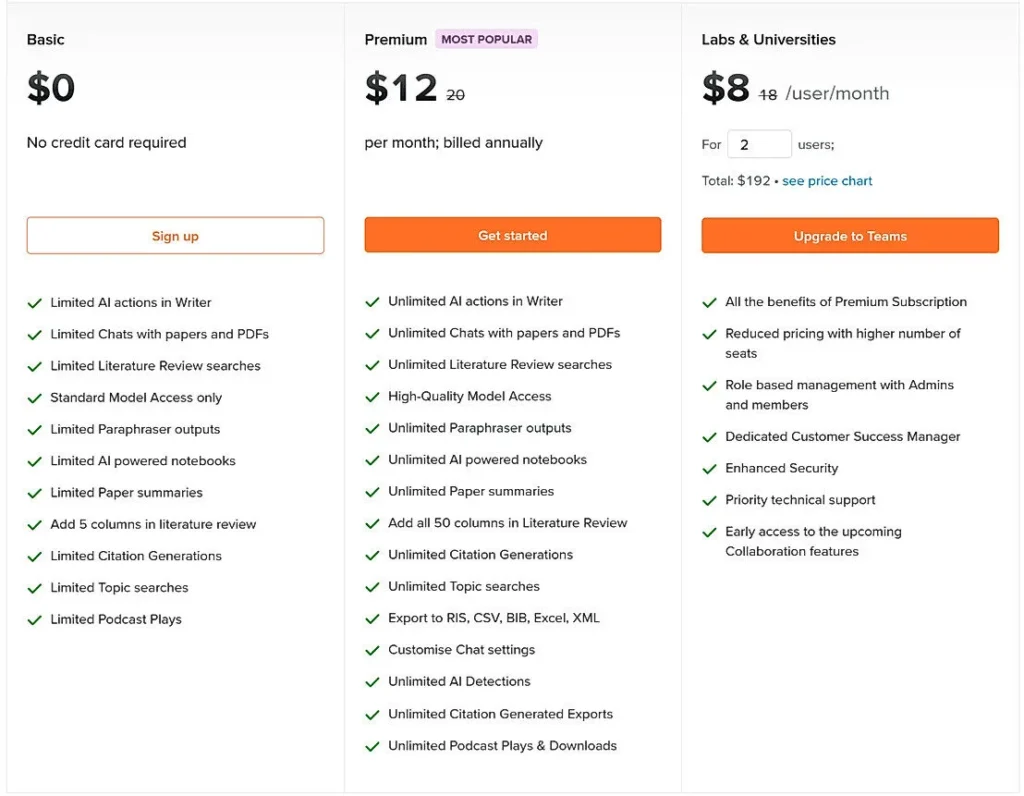
The free plan works well for light daily research with no credit card required, making it a genuine frictionless entry point. Premium at $12/month annually is one of the strongest value-per-dollar offers in the AI research tools category — unlimited searches, full AI Writer, high-quality models, and RIS/CSV export for less than the price of a coffee per week.

Deep Review alone may justify the $90/month Advanced plan for researchers running systematic reviews regularly, as it replaces a process that normally takes weeks of manual screening. If you read, synthesize, or write from academic literature on a regular basis, SciSpace earns its cost within the first literature review of the month.

SciSpace (formerly Typeset.io) is an AI-powered academic research platform developed by Typeset, Inc. that gives users access to over 285 million research papers through natural-language semantic search, PDF chat, automated literature review, and AI-assisted academic writing.

Trusted by over 1 million researchers from 100+ countries — including faculty at MIT, Stanford, and Yale and researchers at Nobel Prize-winning institutions — the platform covers the full academic workflow from paper discovery to manuscript drafting, with automatic citations and Zotero, Mendeley, and CSV export support.

• Semantic Search Across 285 Million Papers — Submit a research question in plain language instead of keywords; SciSpace returns a synthesized cited answer plus ranked individual papers, letting you find relevant literature that keyword searches would miss.

• AI Extraction Columns — Add custom analysis columns across your entire paper library simultaneously; compare methodologies, conclusions, limitations, or any custom criteria across dozens of PDFs in a unified sortable table without opening a single document.

• Chat with PDF — Upload any paper and ask questions about its content in natural language; responses include page-level source citations and correctly interpret figures, tables, equations, and methodology sections.

• Deep Review Agent (Advanced) — Triggers an autonomous AI agent that processes up to 1,750 papers, identifies the most relevant subset, and generates a structured comprehensive literature synthesis with in-text citations — replacing weeks of manual systematic review screening.

• AI Writer with Real-Time Citation Suggestions — Drafts academic text in real time while recommending relevant citations directly from the SciSpace database; the reference list updates automatically as you write.

• Library Search & Report Writing Sub-Agent (2026) — Import your own PDFs or Zotero/Mendeley libraries and instruct the sub-agent to generate a full manuscript-style research report with proper academic structure, including introduction, body sections, and a reference list.

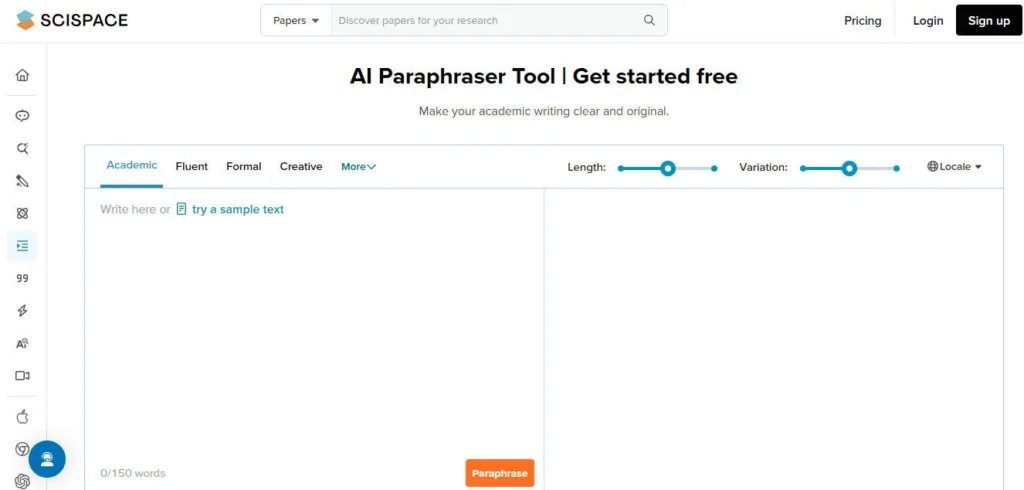
• Paraphraser with 20+ Tones — Rewrites academic text across more than 20 preset tones (formal, simplified, technical, accessible), translates text into any language, and adjusts output length to suit different publication or audience requirements.

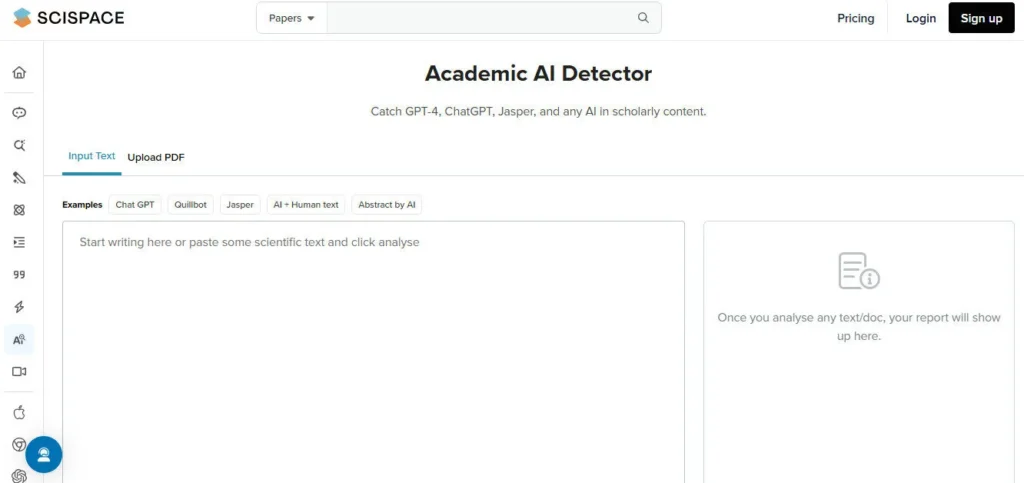
• AI Content Detector & Plagiarism Check — Analyzes documents sentence-by-sentence for AI-generated content and runs Turnitin-powered plagiarism detection, addressing growing institutional academic integrity requirements for submissions.

Pros
  • Semantic search queries 285 million papers in natural language — no keyword guessing required
  • Free plan requires no credit card and is functional enough for daily light research use
  • Premium plan at $12/month annually includes unlimited search, AI Writer, high-quality models, and RIS/CSV export
  • PDF Chat cites the exact page and passage for every AI response, making verification instant
  • Zotero and Mendeley import support connects your existing reference library without manual re-uploading
  • Deep Review processes up to 1,750 papers and produces a structured review synthesis in minutes
  • Coverage of 55,000+ research institutions and 150 publishing partners ensures broad database access
Cons
  • ×Deep Review is locked exclusively behind the Advanced plan at $90/month — a steep jump from Premium at $20/month
  • ×Free plan restricts export to Zotero, BibTeX, and CSV formats, forcing paid upgrade for standard reference workflows
  • ×AI extraction columns and semantic search are not fully reproducible, making the tool unsuitable as the primary search method for formal systematic reviews
  • ×PDF Chat accuracy drops with highly visual, formula-heavy, or data-table-dense papers outside standard text-based formats
  • ×No dedicated desktop app or mobile app — the platform is browser-only, limiting offline or on-the-go research use
  • ×Teams plan at $18/user/month is priced competitively but lacks granular admin controls reported by enterprise reviewers

SciSpace is built for anyone who regularly reads, synthesizes, or writes from academic literature and wants AI to handle the time-consuming parts of that process.

• PhD students and postgraduate researchers — Literature reviews that normally take weeks can be completed in hours using semantic search, AI extraction columns, and Deep Review; the Premium plan at $12/month annual is well within typical student budgets.

• Graduate and undergraduate students — PDF Chat helps students understand complex papers outside their specialty, including unfamiliar methodology sections, tables, and equations, with source-cited answers in plain language.

Research scientists in pharma, biotech, and technology — R&D teams use multi-PDF data extraction and patent search capabilities for competitive intelligence and systematic evidence synthesis across large document sets.

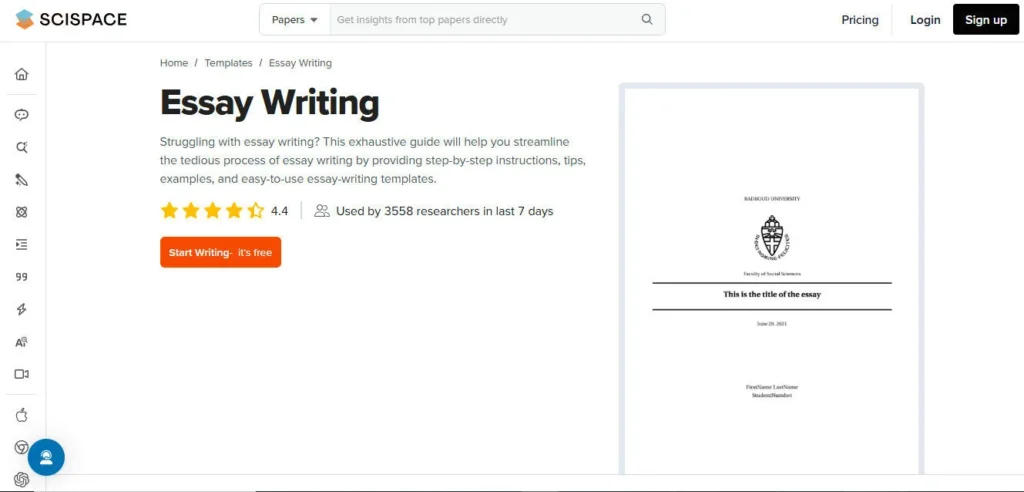
• Academic writers and manuscript authors — Researchers writing for publication use the AI Writer with real-time citation suggestions and the paraphraser with 20+ tones to draft, refine, and format manuscripts without switching tools.

• Science journalists and educators — Text simplification and multi-language support make complex academic findings accessible to general audiences or students without specialist domain knowledge.

Free/Basic ($0/mo)No credit card required, daily document chat access, basic AI search across 285M papers, limited extraction columns (up to 3 per table), access to lower-tier AI models, no CSV/RIS/BibTeX export.
Premium ($20/mo billed monthly, $12/mo billed annually)Unlimited searches across 285M papers, full AI Writer with real-time citation suggestions, high-quality AI models, unlimited PDF chat, RIS/CSV/BibTeX export, Zotero/Mendeley import and export support, unlimited extraction columns.
Teams ($18/user/month billed monthly, $8/user/month billed annually)Everything in Premium plus shared team workspaces, collaborative library management, SAML SSO for enterprise authentication, team analytics and usage reporting, centralized billing management.
Advanced ($90/mo)Everything in Premium plus Deep Review agent (processes up to 1,750 papers per review), 5,500 monthly credits, up to 100 extraction columns for systematic meta-analyses, priority access to highest-tier AI models, Report Writing Sub-Agent for manuscript-style outputs, Library Search across personal uploaded PDFs.

SciSpace stands apart by covering the full academic research workflow end-to-end — discovery, analysis, synthesis, and writing — in a single platform without requiring tool-switching.

• Deep Review Agent with 1,750-Paper Processing — No competing AI research tool at this price point autonomously screens this volume of papers, identifies the most relevant subset, and produces a structured cited synthesis in one continuous agentic operation. For systematic review preparation, it replaces weeks of manual abstract screening.

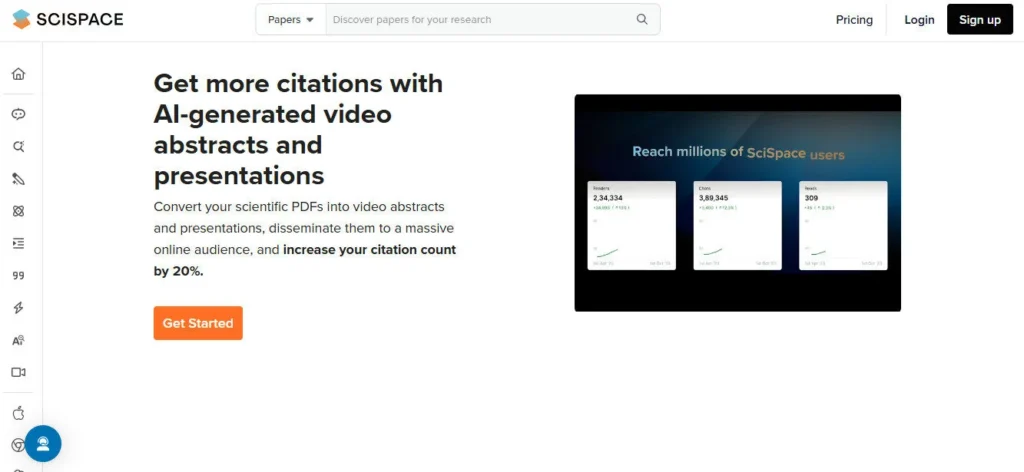
• PDF-to-Video Converter — SciSpace converts research papers into AI-narrated video summaries shareable on social media platforms — a unique capability for science communicators and educators that no other dedicated academic research tool currently offers.

• Turnitin-Powered Plagiarism Detection Built In — Unlike standalone AI writing tools, SciSpace integrates institutional-grade plagiarism detection directly inside the platform, letting researchers check academic integrity without subscribing to a separate service.

• Multi-Language Chat with Any Paper — The Chat with PDF feature operates in any language regardless of the source paper's language, enabling researchers to extract insights from international literature in their native language — a critical capability in multilingual academic environments.

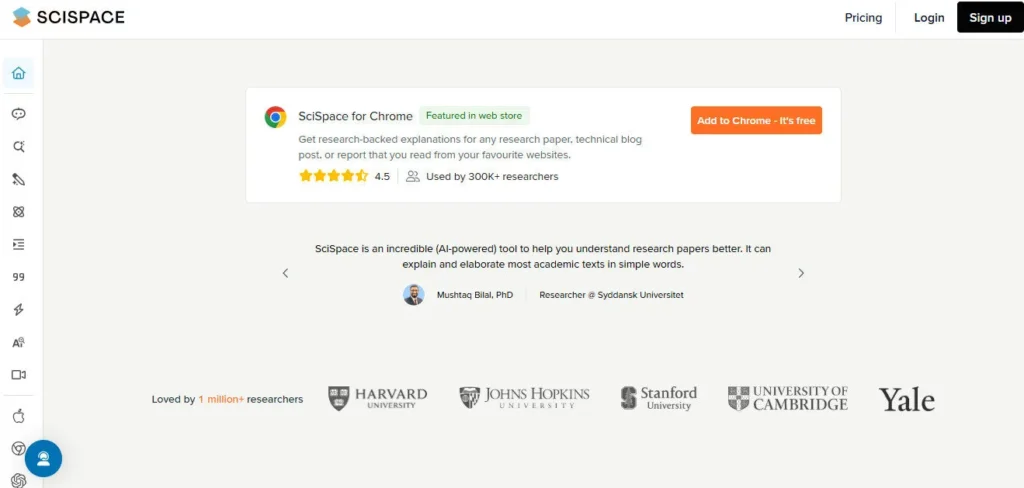
SciSpace runs as a web app accessible in all major browsers and includes a Chrome extension for reading papers directly on any website.

• Chrome Browser Extension — Install from the Chrome Web Store and interact with any research article page directly in your browser; ask questions, get summaries, and translate findings without leaving the page or importing files manually.

• Zotero and Mendeley Integration — Import your existing reference libraries directly into SciSpace; the 2026 update also adds library search capabilities so the AI agent can query and synthesize your personal imported PDFs from these reference managers.

• RIS, CSV, and BibTeX Export (Premium and above) — Export your annotated paper library and citation data to standard reference manager formats compatible with Zotero, Mendeley, EndNote, and LaTeX workflows.

ChatGPT Custom GPT Integration — SciSpace connects with ChatGPT Plus via a custom GPT assistant, combining SciSpace's 285-million-paper database with ChatGPT's conversational interface for citation-backed answers directly inside ChatGPT.

• All Major Web Browsers — Fully browser-based and compatible with Chrome, Firefox, Safari, and Edge on desktop; no software installation required, with the platform accessible immediately upon free signup at scispace.com.

CategoryScoreWhy It Matters
Accuracy & Reliability4.5/5SciSpace grounds every response in specific papers from its 285-million-paper database or user-uploaded PDFs, with page-level citations that make one-click verification possible. PDF Chat accurately interprets figures, tables, equations, and methodology sections in most standard text-heavy papers. Accuracy drops slightly for highly visual or formula-dense documents, and AI semantic search results are not perfectly reproducible on each query — a known limitation for formal systematic review use.
Ease of Use4.6/5SciSpace requires no setup, no credit card for the free plan, and delivers value within minutes of first use — the semantic search and PDF Chat interfaces are immediately intuitive. The extraction columns, Deep Review, and Report Writing Sub-Agent have a short learning curve, but video tutorials and an active YouTube community significantly ease onboarding. The Chrome extension makes the tool available inline on any research paper page without switching context.
Functionality & Features4.8/5No other AI research tool at this price point combines semantic paper search across 285 million papers, multi-PDF extraction columns, PDF Chat with page citations, Deep Review agent synthesis, AI Writer with real-time citation suggestions, paraphraser with 20+ tones, Turnitin-powered plagiarism detection, AI content detection, Zotero/Mendeley integration, patent search, and PDF-to-video conversion in a single platform. The 2026 Library Search and Report Writing Sub-Agent updates further close the gap between AI assistance and full autonomous research output.
Performance & Speed4.4/5Standard PDF chat, semantic search queries, and extraction column generation return results within seconds. Deep Review takes 5–15 minutes depending on the scope of the query, which is reasonable given it processes up to 1,750 papers autonomously. The Report Writing Sub-Agent takes a few minutes to generate structured manuscripts. No significant platform downtime has been widely reported across the 1 million-plus user base, and the 2026 Zotero import and Library Search features have been praised for speed in early user reviews.
Customization & Flexibility4.3/5Custom AI extraction columns let users define any analysis criteria across their paper library in plain language, enabling highly flexible comparative analysis tailored to each research project. The paraphraser offers over 20 tones including formal, simplified, technical, and accessible registers. Zotero and Mendeley integration preserves existing reference workflows. The main flexibility gap is that SciSpace does not support custom fine-tuning of its AI models or connection to specialized domain databases beyond its built-in corpus.
Data Privacy & Security4.0/5The Teams plan includes SAML SSO for enterprise authentication, suggesting structured security architecture for institutional use. SciSpace is deployed by researchers at Roche, Pfizer, and Goldman Sachs, indicating acceptable enterprise-grade standards in practice. However, SciSpace does not prominently publish SOC 2 certification, GDPR compliance statements, or data retention policies on its public website — a transparency gap that may concern researchers handling sensitive clinical trial data or proprietary R&D documents.
Support & Resources4.3/5SciSpace is supported by a large and active community of research YouTubers producing regular tutorials, walkthroughs, and workflow guides — including multiple verified channels with hundreds of thousands of subscribers. Official documentation is detailed and kept up-to-date with new feature releases. Dedicated support for Teams and Advanced plan users is available. Standard free and Premium plan users rely on community forums and help articles, with no published SLA response times for ticket-based support.
Cost-Efficiency4.7/5At $12/month billed annually, the Premium plan delivers unlimited searches, full AI Writer, high-quality AI models, Zotero/Mendeley integration, and RIS/CSV export — a combination that would cost significantly more across separate specialized tools. The free plan covers real daily research needs without requiring payment, making it one of the most generous free tiers in the academic AI tools market. The Advanced plan at $90/month is priced at the high end for individual users but competes favorably with the cost of hiring a research assistant for systematic review screening.
Overall Score4.5/5SciSpace is the most complete and best-value AI research platform available in 2026, earning adoption from over 1 million researchers across institutions ranging from MIT and Stanford to pharma companies and government research bodies. Minor limitations in formal reproducibility for systematic reviews and limited public security documentation prevent a perfect score, but for any researcher or student working with academic literature regularly, SciSpace delivers unmatched functional breadth at a price that is hard to argue against.

SciSpace is the most functionally complete AI research platform available in 2026, covering semantic paper discovery, PDF chat, multi-document extraction, Deep Review synthesis, AI-assisted writing, paraphrasing, plagiarism detection, and citation generation in a single workspace. At $12/month annually on the Premium plan, it offers exceptional value for individual researchers and students; the $90/month Advanced plan with Deep Review is best justified for researchers running formal literature reviews regularly.

The main limitation is that AI-driven searches are not reproducible, making it a research accelerator rather than a replacement for rigorous systematic review methodology.

Q1.What is SciSpace and who makes it?
Ans:-SciSpace is an AI-powered academic research platform developed by Typeset, Inc., formerly known as Typeset.io. It gives users access to over 285 million research papers through natural-language semantic search, PDF chat, automated literature review, and AI-assisted academic writing. The platform is trusted by over 1 million researchers from 100+ countries, including faculty and students at MIT, Stanford, and Yale.
Q2.Is SciSpace free to use?
Ans:-Yes. SciSpace offers a permanently free Basic plan with no credit card required. It includes daily PDF chat access, basic semantic search across 285 million papers, and limited extraction columns. Export to RIS, CSV, and BibTeX is restricted to paid plans. The free plan is functional for light daily research but most active users will need Premium at $12/month (billed annually) for unlimited use.
Q3.What is SciSpace Deep Review and is it worth it?
Ans:-Deep Review is an AI agent on the Advanced plan ($90/month) that autonomously processes up to 1,750 papers for a given research query, identifies the most relevant subset, and generates a structured cited literature synthesis. It is specifically designed for systematic review preparation and significantly reduces the manual abstract-screening workload. For researchers running regular formal literature reviews, Deep Review alone can justify the Advanced plan cost.
Q4.How accurate is SciSpace for academic research?
Ans:-SciSpace is more reliable than general-purpose AI chatbots because every response is grounded in specific papers from its database or your uploaded PDFs, with page-level citations attached. PDF Chat traces answers to exact passages, making verification a one-click process. Accuracy is high for text-based papers, but drops slightly for highly visual, mathematical, or formula-heavy documents. The platform is not suitable as the sole search method for formal systematic reviews due to non-reproducible AI search results.
Q5.Can SciSpace integrate with Zotero or Mendeley?
Ans:-Yes. SciSpace supports Zotero and Mendeley integration for importing your existing reference library into the platform. As of the 2026 update, the Library Search feature also lets the AI agent query and synthesize papers you have imported from these reference managers. Export to BibTeX and RIS formats (compatible with both Zotero and Mendeley) is available on Premium and above plans.
Q6.What is the difference between SciSpace Premium and Advanced?
Ans:-Premium at $20/month (or $12/month billed annually) covers unlimited search, PDF chat, full AI Writer, high-quality models, and RIS/CSV export — the full standard research toolkit. Advanced at $90/month adds Deep Review (up to 1,750-paper agent synthesis), 5,500 monthly credits, up to 100 extraction columns for meta-analyses, and the Report Writing Sub-Agent for manuscript-style outputs. The jump is significant, and Advanced is best justified for researchers doing systematic or large-scale reviews frequently.
Q7.Does SciSpace have a Chrome extension?
Ans:-Yes. The SciSpace Chrome extension lets you interact with any research article page directly in your browser without importing files into the app. You can ask questions, summarize results, and extract key findings from papers on Google Scholar, PubMed, ScienceDirect, or any website where a paper is displayed. The extension also supports multi-language conversations, so you can read papers in English and ask questions in your native language.
Q8.Can I use SciSpace for a systematic literature review?
Ans:-SciSpace is a powerful assistant for systematic review preparation, but its AI semantic search produces slightly different results on each run, making it non-reproducible by the standards required for formal systematic reviews. Best practice is to conduct the reproducible keyword search in databases like PubMed or Scopus first, then import those results into SciSpace to use extraction columns and PDF Chat for data analysis and synthesis. This hybrid approach gives you both reproducibility and AI-accelerated analysis.
Q9.What AI models does SciSpace use?
Ans:-SciSpace uses high-quality AI models on Premium and above plans, while the free Basic plan is restricted to lower-tier models. The platform's AI research agent on the Advanced plan orchestrates over 150 specialized internal tools for complex tasks including Deep Review, report writing, and patent searches. SciSpace does not publicly name the specific underlying LLM providers, but the quality gap between free and paid plan models is clearly noticeable in response depth and citation precision.
Q10.How does SciSpace compare to Elicit or Consensus for research?
Ans:-SciSpace offers a broader functional scope than either Elicit or Consensus. Elicit specializes in structured data extraction for systematic reviews; Consensus focuses on consensus-based academic Q&A. SciSpace combines both capabilities — semantic search, extraction columns, PDF chat, Deep Review synthesis — and extends further with an AI Writer, paraphraser, plagiarism detection, citation generator, Zotero/Mendeley integration, and PDF-to-video conversion. For researchers wanting one tool across their entire workflow, SciSpace's functional range is unmatched at comparable pricing.

Promote This Tool

Help others discover this tool by sharing this page.

✓ Link copied to clipboard!

SciSpace Reviews

0.0
Based on 0 reviews
5 star
0%
4 star
0%
3 star
0%
2 star
0%
1 star
0%

Write a Review

Your Rating:

No reviews yet. Be the first to share your thoughts!

40 Similar SciSpace Tools